Your 30s are, for most people, their peak earning years. You are likely earning more than you ever have, which means you are capable of saving more than you ever have. The catch is that this is also the decade when life gets expensive — a mortgage appears, children arrive, and so does the temptation to let your spending rise to meet your income. That last point is the whole game, in one sentence: the key to your 30s is to invest the raise, not spend it.
This guide sets out a practical, plain-language plan for making the most of the decade. We will walk through financial priorities in order, look at example portfolios that lean into the fact that you have decades of growth ahead, put a number on the cost of waiting, and cover the tax-advantaged accounts that do most of the heavy lifting.
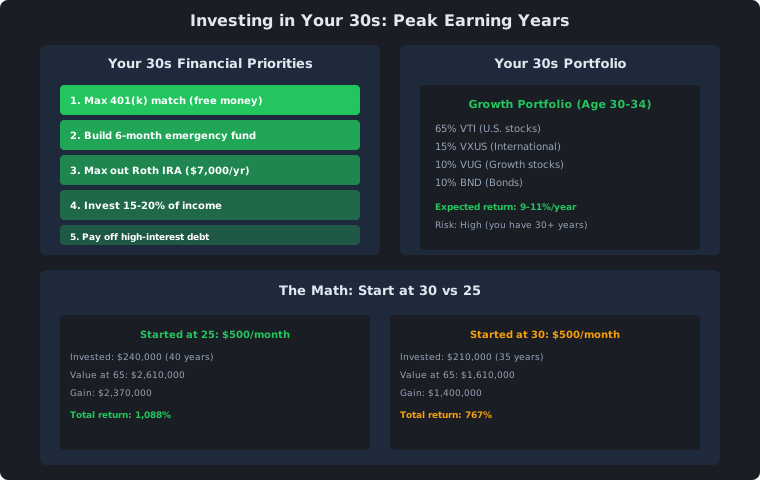
Your 30s financial priorities
The order you handle things matters more than any single decision, because each step makes the next one possible. A useful sequence looks like this:
| Priority | Action | Why |
|---|---|---|
| 1 | Capture your employer’s 401(k) or pension match | It is free money on top of your own contribution |
| 2 | Build an emergency fund of several months’ expenses | Roughly $15-25K in the US examples — so you never sell investments in a panic |
| 3 | Max out a Roth IRA (around $7,000 a year in the US examples) | Tax-free growth and tax-free withdrawals in retirement |
| 4 | Invest 15-20% of income | This is where wealth is actually built |
| 5 | Pay off high-interest debt | Credit cards and personal loans first, before investing aggressively |
Notice what is at the top. Too many people jump straight to investing while carrying credit-card debt and no emergency fund, then get forced to sell at the worst moment when life goes wrong. Fixing those first means your long-term investments get to stay invested, which is where their power actually comes from.
A portfolio that fits your 30s
Because you still have 30 years or more until retirement, your 30s portfolio can carry far more risk than one for someone in their 50s or 60s. Time is the great absorber of volatility — a sharp drop in your early 30s is a buying opportunity over a three-decade horizon, not a catastrophe. Two example allocations give a sense of the shape:
Growth portfolio (roughly age 30-34)
| Asset | Allocation | Example fund |
|---|---|---|
| U.S. stocks | 65% | VTI |
| International stocks | 15% | VXUS |
| Growth stocks | 10% | VUG |
| Bonds | 10% | BND |
The expected long-run return for such a mix has historically been in the region of 9-11% a year, though that is a long-term average, not a promise for any single year.
Balanced growth (roughly age 35-39)
| Asset | Allocation | Example fund |
|---|---|---|
| U.S. stocks | 55% | VTI |
| International stocks | 15% | VXUS |
| Bonds | 20% | BND |
| REITs | 10% | VNQ |
Here the expected return is historically more like 8-10% a year. The shift is modest — a slightly lower share of U.S. stocks, a higher bond slice and a touch of property for diversification. The fund tickers are US-market examples; the equivalent in any country will be a low-cost tracker of a similar index. The principle matters more than the ticker: lean towards growth, keep costs low, and add enough bonds to stop yourself panicking when markets fall.
The real cost of waiting
One of the most motivating facts about money is how expensive procrastination is, and the numbers from the original article make the point vividly. In the US example, saving $500 a month:
| Scenario | Start age | Monthly | Value at 65 |
|---|---|---|---|
| Started at 25 | 25 | $500 | Roughly $2,610,000 |
| Started at 30 | 30 | $500 | Roughly $1,610,000 |
| Difference | Roughly $1,000,000 |
On those assumptions, waiting five years cost roughly a million dollars — because the money you never invested also never compounded for those five extra years. That is the cruelest part of compound growth: the lost time is lost forever.
But the good news is just as real: you can claw much of it back by saving more. In the same example, $750 a month starting at 30 lands you near $2.4 million at 65 — close to what the lighter saver achieved by starting at 25. You cannot get the years back, but you can absolutely raise the monthly amount. That is the honest summary of the 30s dilemma: modest delay is survivable, inaction is not.
How much to invest by income
The 15-20% target can feel abstract, so it helps to see what it means in money. The US example assumes a 15% saving rate compounded over 35 years:
| Income | 15% saved (yearly) | Monthly | Approx. 35-year value |
|---|---|---|---|
| $50,000 | $7,500 | $625 | $1.6M |
| $60,000 | $9,000 | $750 | $1.9M |
| $75,000 | $11,250 | $938 | $2.4M |
| $100,000 | $15,000 | $1,250 | $3.2M |
These are illustrative projections built on assumptions about returns that will not repeat themselves precisely — they exist to show that a fixed fraction of your income, invested consistently over a long period, produces results that scale with what you earn. The habit of a percentage, not a fixed pounds-or-dollars figure, is what keeps you saving as your pay rises.
The tax-advantaged accounts to use
The wrappers you invest inside matter enormously, because tax-free compounding is worth far more over three decades than most people realise. In the US example, the main options were:
| Account | 2026 limit (from original) | Tax benefit |
|---|---|---|
| 401(k) | $23,500 | Pre-tax contributions |
| Roth IRA | $7,000 | Tax-free growth |
| HSA | $8,300 (family) | Triple tax advantage |
| 529 Plan | Varies | Tax-free education |
The equivalent structure in the UK centres on ISAs (tax-free savings) and workplace pensions with employer contributions and tax relief. The exact figures and limits change year on year, so check what applies in your country and current tax year. The principle is universal though: use your tax-advantaged allowances before you invest anywhere else. If you are paying the brokers for a taxable account while leaving money on the table in a tax-free wrapper, you are giving away returns.
Mistakes that quietly drain your 30s
The biggest risks in your 30s are not market crashes — they are slow, habitual decisions that compound into lost wealth. The common ones are:
- Lifestyle creep. Spending each raise instead of investing a slice of it. This is the quiet killer of the whole decade.
- Ignoring the employer match. Leaving free money unclaimed while funding other accounts.
- Being too conservative. With 30 years to go, holding mostly cash or bonds sacrifices the growth your timeline actually supports.
- Not increasing contributions. The 30s plan works best when you raise your monthly investing by roughly 1% of income a year as your earnings grow.
The single best defence against all of these is automation. Set up automatic transfers on payday so the investing happens before you ever see the money — if it never hits your spending account, you will not spend it. Invest first, live on the rest, and review the allocation once a year to bring it back in line with your targets. This is educational guidance rather than financial advice, so tailor the numbers to your own situation, but the core lesson of the decade is close to universal: save a fixed share, automatically, in tax-advantaged accounts, and let three decades of compound growth do the heavy lifting.
Bottom line
Your 30s are peak earning years, and they are the decade where a consistent habit does more for your wealth than any clever stock pick. Capture your employer match, build a real emergency fund, pay off the expensive debt, then invest 15-20% of income automatically into a growth-leaning, low-cost portfolio held in tax-advantaged accounts. Accept that early years of compounding are precious, raise your contributions as you earn more, and resist the lifestyle creep that makes higher pay vanish. Get those few things right and you set up the rest of your working life — not by doing anything exotic, just by doing the consistent, boring things well.