Dividend investing is one of the most straightforward ways to build a stream of income you do not strictly have to work for. When you own dividend-paying stocks or exchange-traded funds, they send you money every quarter — or even every month — simply because you hold them. For many investors the appeal is that this income can be reinvested to grow your portfolio, and eventually, after years of patient compounding, replace a salary.
None of this happens quickly, and the income is not guaranteed, so it is worth understanding how the machine really works before you set one up. This guide covers the snowball effect, the funds people actually use, how much income is realistic, and the tax questions that most beginners overlook.
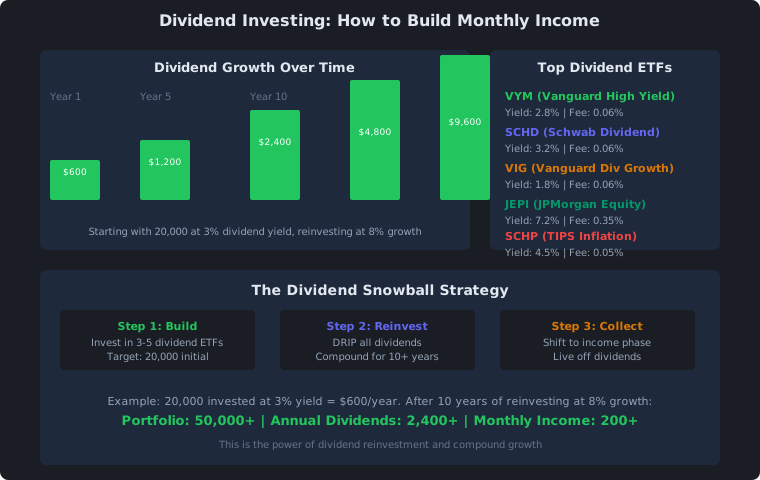
The dividend snowball explained
The strategy sounds almost too simple, and that is a large part of why it works. There are three steps: invest in high-quality dividend-paying funds, reinvest all the dividends you receive, and then wait — often for a decade or more — for compound growth to do its work.
When you reinvest a dividend, you buy more shares. Those extra shares pay more dividends. Those dividends buy still more shares. Each cycle is small in itself, but over ten to twenty years the growth becomes exponential, and the income line starts to rise faster and faster.
To see the scale of what is possible, consider a starting pot of $20,000 earning a 3% yield with dividends reinvested and the portfolio growing at 8% a year. These are rough illustrative numbers, but the shape of the curve is the point:
| Year | Portfolio Value | Annual Dividends | Monthly Income |
|---|---|---|---|
| Year 1 | $20,000 | $600 | $50 |
| Year 5 | $35,000 | $1,200 | $100 |
| Year 10 | $50,000 | $2,400 | $200 |
| Year 15 | $80,000 | $4,800 | $400 |
| Year 20 | $120,000 | $9,600 | $800 |
Notice what happens: the monthly income does not rise in a straight line. It accelerates. That compounding later in the timeline is the entire reason dividend investors talk about patience so much.
Top dividend ETFs for 2026
There is no single “best” dividend fund, but a handful of exchange-traded funds are so widely used that they have become reference points. The yields and fees below are roughly typical at the time of writing and can drift, so treat them as a guide rather than a fixed spec.
VYM (Vanguard High Dividend Yield) sits at the simple, broad end — a yield around 2.8% with an expense ratio of 0.06%, holding 500+ dividend stocks and paying quarterly. It is often used as a core holding because it is cheap, diversified and filled with familiar blue-chip names such as Johnson & Johnson, Procter & Gamble and Coca-Cola.
SCHD (Schwab U.S. Dividend Equity ETF) targets quality rather than sheer yield — around 3.2%, 0.06% expense ratio, 100 high-quality stocks. Its focus on strong balance sheets and consistent dividend growth has made it a popular core position that has historically outperformed many comparable funds over five-plus years.
VIG (Vanguard Dividend Appreciation) takes the growth side: a lower yield, around 1.8%, but it holds companies that have increased their dividends for 10+ consecutive years. You accept less income today for the promise of faster dividend growth tomorrow.
JEPI (JPMorgan Equity Premium Income) pays monthly rather than quarterly and carries a much higher yield, around 7.2%, at a 0.35% expense ratio. It generates that income partly through options strategies, which is why the yield stands out — but it has less dividend growth potential behind it.
SCHP (Schwab U.S. TIPS ETF) is a different beast: it holds inflation-protected bonds, yields around 4.5%, and pays monthly. It is not a stock fund at all, but its role in a dividend portfolio is inflation protection — a steady income leg that adjusts with the cost of living.
The three-fund dividend portfolio
You do not need a long list of funds to get going. A common, sensible structure is a core, a yield boost and an inflation hedge, roughly along these lines:
| Fund | Allocation | Purpose |
|---|---|---|
| SCHD | 60% | Core dividend growth |
| VYM | 25% | High yield exposure |
| SCHP | 15% | Inflation protection |
Put together, such a portfolio gives you a combined yield of roughly 3.0%, an average expense ratio of about 0.06%, and a plausible long-run expected return in the 8-10% range when you add in capital growth. The exact allocation is a starting template, not a law — the important habits are diversification across sectors, keeping costs low, and reinvesting.
How to start
The mechanics of starting are simple enough to be the least intimidating part. Set up an account, arrange automatic monthly contributions, buy your chosen funds according to your allocation, and switch on dividend reinvestment so you never have to think about it. Rebalance once a year — if your core has grown to 65% of the portfolio, trim it back toward 60% and buy more of whatever has lagged.
A more important early decision is which kind of account to use, because it shapes how much of your dividends you actually keep. In the UK the standout option is an ISA, which shelters all dividend income from tax. In US-style accounts, a Roth IRA offers tax-free dividends for long-term growth, a traditional IRA defers tax until withdrawal, and a taxable brokerage gets dividends taxed each year — qualified dividends at rates from 0% up to 20%, non-qualified ones as ordinary income. The practical rule is simple: hold your high-yield funds inside a tax-advantaged wrapper and keep them out of a taxable account wherever you can.
Moving into income mode
Dividend investors typically spend their twenties and thirties in pure growth mode, reinvesting everything, before gradually switching the income on. A rough timeline would see a 30-40 year old reinvest (no income taken), a 40-50 year old still reinvesting while a small monthly amount starts to appear, a 50-60 year old taking partial income, and someone 60+ in full income mode. Monthly income targets appropriate at each stage really depend on your own pot, but the pattern of building first, then harvesting, is the sensible template.
Avoiding the yield trap
The biggest single mistake in dividend investing is chasing yield. A stock offering an 8-10% yield while its peers offer 3-4% is usually not a gift — it is the market signalling that a dividend cut is coming. Combine a high yield with a declining business and you have the classic “yield trap”: generous income today, a slashed or cancelled dividend tomorrow, and a falling share price into the bargain.
When a dividend is cut, the damage is double — you lose the income and the stock usually falls. That is why diversification across utilities, consumer staples and healthcare matters, and why a fund of a hundred quality payers is almost always safer than one concentrated bet. The rule of thumb worth remembering is simple: a yield above 6% demands investigation before investment.
The bottom line
Dividend investing will not make you rich overnight, but as a disciplined long-term strategy it is about as dependable as equity investing gets. It works best when you keep costs low (a fraction of one percent in fees), reinvest everything in the early years, hold a diversified spread of quality payers, and keep the whole thing inside a tax-advantaged wrapper like an ISA. If you do that, the income builds slowly at first and then accelerates — genuinely meaningful monthly income tends to arrive after a decade or more of patience. It is a marathon, not a sprint, and that is precisely why it works. None of this is financial advice; your own tax position is worth confirming with an adviser before you rely on it.