At 50, retirement might feel both close and impossibly far at the same time. You have something like fifteen years before a conventional retirement age — a long enough stretch that compound growth still has real power, but short enough that the mistakes you make now have little time to repair themselves. The good news is that the rules actively help people in your position: once you pass 50 in the US example, catch-up allowances let you put far more into tax-advantaged accounts than a younger saver can, and that extra headroom, combined with steady compounding, genuinely makes a comfortable retirement achievable rather than aspirational.
This guide explains how to use those catch-up allowances, the sensible order to fund your accounts, a balanced portfolio for the decade ahead, realistic projections for what you can achieve, and the one mistake that quietly destroys more 50-something retirements than any market crash.
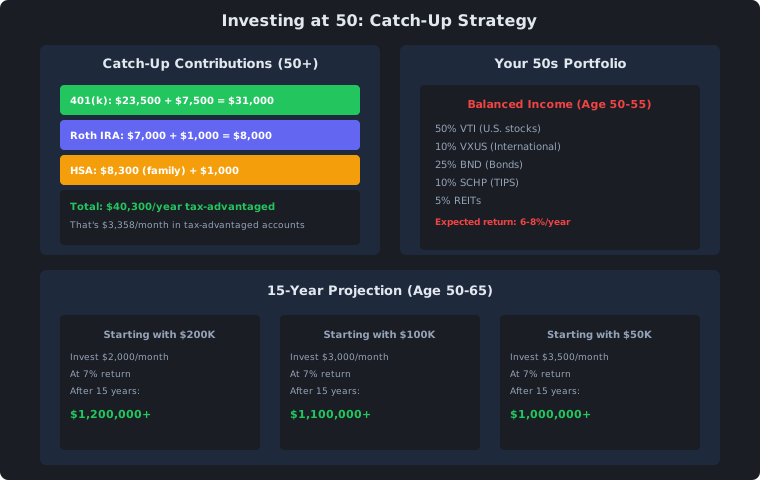
The catch-up advantage
Your single biggest advantage at 50 is that the tax system gives you more room to save than it gives virtually anyone else. In the US example, the catch-up provisions lift the annual limits:
| Account | Standard | Catch-up | Total |
|---|---|---|---|
| 401(k) | $23,500 | $7,500 | $31,000 |
| Roth IRA | $7,000 | $1,000 | $8,000 |
| HSA | $8,300 | $1,000 | $9,300 |
| Total | $38,800 | $9,500 | $48,300/year |
That works out to around $4,025 a month in tax-advantaged savings, of which roughly $1,600 a month is headroom you did not have before 50. Those are US figures from the original article, so if you are in the UK the equivalents differ — the point that nothing is wrong with your plans is the catch-up principle itself, and the note that every extra pound or dollar you save now compounds for fifteen years.
That compounding is why the catch-up allowances matter so much. The extra $9,500 a year is not just money invested; it is money invested tax-free or tax-deferred for the fifteen years until retirement, which is why the original article estimated the extra allowance alone could grow to $300,000 or more by the time you retire.
Fund your accounts in this order
Not all accounts are created equal, so the sequence you fund them in shapes your final tax bill. A sensible order:
- Employer 401(k) match first — an instant, guaranteed return of 50-100%, the best “investment” on the entire list.
- HSA up to the limit — contributions are pre-tax, growth is tax-free, and withdrawals for qualifying healthcare are tax-free. This triple advantage makes it, for many, the most valuable account they own.
- Roth IRA, or backdoor Roth if you exceed the income limit — tax-free withdrawals in retirement, and no required minimum distributions dragging it out.
- Remaining 401(k) up to the catch-up limit — the largest tax-advantaged bucket you have, and the one that soaks up the rest of your savings.
If you can only do part of this list, do it in this order — the free match and the triple-taxed HSA outrank the rest for most people.
A portfolio for your 50s
At 50 you still have fifteen years of growth ahead of you and potentially thirty or more years in retirement, so the portfolio should not be the near-cash allocation many people instinctively reach for. One worked example from the original article keeps you in the market while adding serious ballast:
Balanced income portfolio (roughly age 50-55)
| Asset | Allocation | Example fund |
|---|---|---|
| U.S. stocks | 50% | VTI |
| International stocks | 10% | VXUS |
| Bonds | 25% | BND |
| TIPS | 10% | SCHP |
| REITs | 5% | VNQ |
The expected long-run return here has historically been in the region of 6-8% a year. The 25% bond allocation and 10% inflation-protected TIPS provide ballast that smooths the ride, while the stock component still outpaces inflation over fifteen years. If you are further from retirement, or have a large existing pot, you can lean towards the stock-heavy end of the range; the important habit is to rebalance back to your chosen targets about once a year so drift does not quietly tilt the whole portfolio.
What you can realistically build
The original article’s projections show that the monthly amount you save, more than your starting pot, decides whether you retire comfortably. The numbers assume a 7% annual return:
| Starting amount | Monthly contribution | Return | Value at 65 |
|---|---|---|---|
| $200,000 | $2,000 | 7% | $1,203,000 |
| $100,000 | $3,000 | 7% | $1,236,000 |
| $50,000 | $3,500 | 7% | $1,252,000 |
The stated return is an assumption, not a promise, so treat the values as illustrative. But the pattern is the real lesson: $2,000 a month over fifteen years is $360,000 of your own money, and at a 7% assumption the compounding on top adds roughly $843,000 — more than doubling your contributions. Even from a starting pot of just $50,000, monthly savings of $3,500 reach the $1.2 million mark on those figures. At 50, the saving rate is the lever that matters.
Working out the number you need
To turn a pot into an income, the classic starting point is the 4% rule — withdraw about 4% of your portfolio in year one, adjusted for inflation, with a historically high probability of the money lasting thirty years. That implies aiming for 25 times your annual spending:
| Monthly retirement need | Portfolio required (4% rule) |
|---|---|
| $3,000 | $900,000 |
| $4,000 | $1,200,000 |
| $5,000 | $1,500,000 |
| $6,000 | $1,800,000 |
So $48,000 a year of retirement spending implies a target of roughly $1.2 million. The refinement that makes it realistic is to subtract any guaranteed income first: if Social Security or a UK state pension is going to deliver, say, $2,000 a month, that reduces the portfolio you need by around $600,000 on the 4% logic. Start from your actual expenses and your real pension entitlement, not a headline figure, and you will know exactly how much monthly saving the gap requires.
The mistake that costs the most
Nearly every 50-something fears being out of the market and losing money. But the evidence in the original article points the other way: the most expensive mistake at 50 is going too conservative. If you retreat into a 60% bond portfolio, the real return after inflation might be only around 3% a year. On those figures, the same $2,000 a month reaches only about $447,000 at 65 — not the $1.2 million the balanced portfolio projected. That is a difference of roughly $750,000 caused purely by asset allocation, with no extra risk to your day-to-day comfort in exchange for a much thinner retirement.
The other common mistakes are variations on the same theme of caution and complacency: not using the catch-up allowance because it feels like too much; letting worry about the past stop you acting now; sacrificing your own retirement savings for a child’s wedding; and ignoring healthcare costs, which the HSA is designed to cover. None of these are about market timing — they are about using the rules and the time you have, steadily, from today.
Three moves that add up
Beyond the portfolio itself, three small decisions can quietly add a great deal to your retirement:
- Delay claiming Social Security (or state pension) to 67-70. Every year you wait past full retirement age typically boosts the benefit by around 8%, adjusted for inflation. If your health allows, this is one of the most reliable returns available.
- Consider Roth conversions in low-income years. If you have a year where your income drops before claiming Social Security, converting traditional IRA money to a Roth up to your tax bracket locks in low or zero tax on that money’s future growth.
- Budget for the healthcare gap. Medicare (or the UK equivalent) does not start until 65, so your 50-64 years need standalone cover. Funding an HSA now covers exactly that period tax-efficiently.
None of these are glamorous, which is rather the point. Retirement at 50 is built from a handful of unglamorous, compounding decisions made in the right order. This is educational guidance rather than financial advice, so confirm the current limits in your country before acting on them.
Bottom line
At 50 the maths still works. Max out the catch-up allowances in the right order — employer match, HSA, Roth, then the rest of your 401(k) — hold a balanced, growth-aware portfolio rather than hiding in bonds, and save $2,000 or more a month where you can. Combine that with delaying your state pension, a sensible withdrawal plan, and the reality that your monthly saving matters more than your starting pot, and a comfortable retirement is within reach. The worst thing you can do is panic about the age you are now — action, from today, beats worry every time.