Retirement does not mean the end of investing — it means changing what your investments are for. In your working years, the goal was growth: build the pot as large as possible. After 60, the goal switches to turning that pot into a dependable stream of income that keeps arriving for as long as you live. That is a different discipline, and it requires a portfolio designed not to shoot the lights out but to be durable: steady, income-producing, and built to last decades rather than a decade.
The figures that matter are the ones about longevity. In the US, for instance, a 65-year-old can expect to live well into their eighties, and a healthy 60-year-old might easily face 30 or more years of retirement. That changes everything. It means you cannot simply hoard cash and hope — inflation would quietly drain it — and you cannot ignore market downturns, because you won’t have the decades to recover that a 30-year-old enjoys. The aim is a careful balance, and it is very achievable.
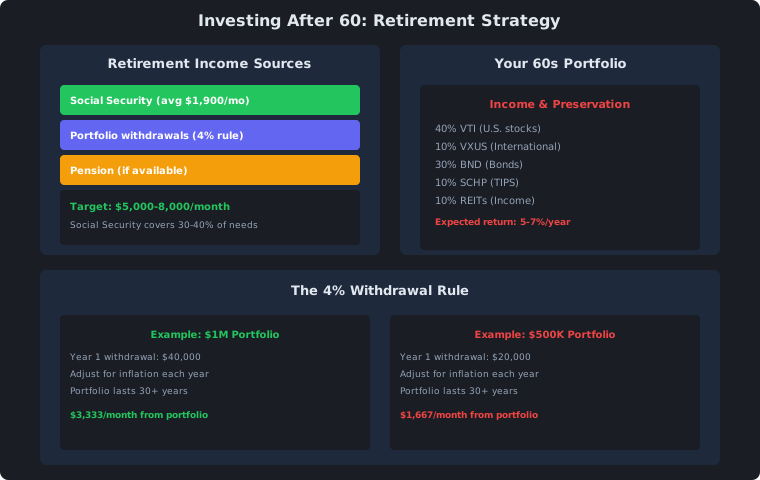
Where your retirement income comes from
Retirement income usually comes from a small number of sources, and most people’s plans involve several at once. In the US context, the split is instructive as a template: Social Security typically provides around 30-40% of income, with the average monthly payment around $1,900; portfolio withdrawals often make up 40-50% of the total; a pension, where one exists, might provide up to around 20%; and part-time work or other income might fill in the last 0-10%. Whatever your country, the exercise is the same: list every source, put a number on it, and work out the gap your portfolio has to fill.
In the UK, the equivalent of Social Security is the state pension, and the same logic applies — the more you can get from a guaranteed, inflation-protected state income, the less pressure on your invested savings. Defined-benefit workplace pensions play the pension role, and many UK retirees also hold a personal pension or ISA savings alongside.
The importance of getting your state income right
Because the state income is guaranteed and, in many cases, adjusted for inflation, it is unusually valuable and worth maximising. The specific numbers are country-specific, but the principle is universal: delaying your claim generally increases the monthly amount you receive for the rest of your life. In the US, the options illustrate the scale: claiming at 62, the earliest point, comes with a reduction of roughly 30% compared with full benefits at 67 (full retirement age); waiting until 70 instead brings a bonus of around 24%. As a rough rule of thumb, delaying from 62 all the way to 70 can boost the monthly amount by roughly 77% — for an average earner, that could mean an extra $600 a month for life.
You don’t need to memorise the numbers; the takeaway is the timing decision. For someone in good health with other assets to draw on, it has historically made sense to wait as long as possible before claiming, because the higher lifetime income usually more than makes up for the years you went without.
The 4% rule: a starting point, not a law
The most famous rule in retirement planning is the 4% rule, and with good reason — it’s simple and it has survived decades of scrutiny. In your first year of retirement, you withdraw 4% of your portfolio. Each year after that, you increase the withdrawal to keep pace with inflation. The claim, based on historical US data, is that a portfolio run this way has a high success rate of lasting 30 years.
To make it concrete, consider a few portfolio sizes. A portfolio of $500,000 would give an annual withdrawal of $20,000, or about $1,667 a month. At $750,000, that’s $30,000 a year, or $2,500 a month. A million dollars produces $40,000 a year, or around $3,333 a month. At $1.5 million it’s $60,000 a year ($5,000 a month), and at $2 million it’s $80,000 a year, or about $6,667 a month. The pattern is linear and easy to apply to whatever number you have.
The important caveat is that 4% is a historical guideline, not a guarantee. Many planners suggest a slightly more cautious rate, often around 3-3.5%, especially if markets are expensive when you retire or if you want a wider margin of safety. Working out your own sustainable figure — ideally with a professional — is always better than blindly applying a rule.
Structuring your portfolio at 60
For the decade from 60 to 65 — the income-and-preservation phase — a common allocation might look like this, and it illustrates the balance most advisers reach for:
| Asset | Allocation | Typical fund | Purpose |
|---|---|---|---|
| US stocks | 40% | VTI | Growth plus dividends |
| International stocks | 10% | VXUS | Diversification |
| Bonds | 30% | BND | Stability and income |
| Inflation-protected bonds | 10% | SCHP | Protection against inflation |
| REITs | 10% | VNQ | Real-estate income |
Funds like these are commonly cited in US planning, and the equivalent UK instruments would be global trackers and gilt or corporate bond funds offered on your platform. The headline expected return for such a portfolio is typically in the range of 5-7% a year, though actual results vary widely. The key features to notice are the diversification across geographies and asset classes, and the roughly 50% stock weighting that keeps growth alive while bonds and inflation-protected holdings blunt the downside.
Why keep so much in stocks at 60? Because of the 30-year runway. Inflation is the silent killer of cautious portfolios: at 3% inflation, prices roughly double in about 24 years. If your money isn’t growing at least at the rate of inflation, your standard of living quietly shrinks. A portfolio that is too conservative may feel safe today but be eroding in real terms.
The bucket strategy for withdrawals
One of the most practical ideas for sequencing your withdrawals is the bucket strategy, which divides your money by how soon you’ll need it. Bucket 1 holds cash and money-market funds covering roughly two years of expenses — this is what you live on in years one and two, so you’re never forced to sell investments at a bad moment. Bucket 2 holds bonds and short-term investments covering around five further years of expenses — this supports years three to seven. Bucket 3 holds everything else in stocks and growth assets, and is left to grow for year eight onwards.
The genius of the approach is psychological and practical at once. By living off cash while the market is weak, you give your long-term investments time to recover before you touch them. The buckets get refilled over time as markets rise, and the whole system smooths out the panic that a single all-in-one withdrawal strategy would otherwise create.
The mistakes that quietly hurt
Retirement planning has its own set of classic errors, and they all share a theme of short-term thinking. Being too conservative is one — it protects today’s balance but lets inflation eat your future spending power. Claiming your state income too early is another, locking in a permanent reduction in monthly income. Not planning for healthcare is a well-known trap; in the US that means budgeting for private cover before Medicare at 65 and for premiums and out-of-pocket costs after, with a planning figure of roughly $300-500 a month. Others include giving large sums to children before securing your own retirement, and ignoring inflation altogether when setting your withdrawal rate.
Each of these is avoidable with a plan made in calm times. And the overarching truth is worth emphasising: at 60, you still have decades ahead of you. Don’t put everything into cash out of fear. Keeping 40-50% in stocks is how you fight inflation and give yourself the best chance of your money outlasting you. Your older self — the one at 90 — will be glad you did.
The bottom line
Investing after 60 is the art of swapping growth for endurance. Know where your income comes from, maximise any guaranteed state income by delaying where it pays, use a sustainable withdrawal rate such as the 4% rule (or a more cautious variant), keep a meaningful allocation in stocks to fight inflation, and structure your withdrawals so you never have to sell at the worst possible time. The goal isn’t to beat the market — it’s to make your money last as long as you do.
This article is educational and not personalised financial advice. Retirement planning is highly individual, so we recommend consulting a regulated financial adviser.