Asset allocation is arguably the single most important decision you will make as an investor. It decides not just how much you might earn, but how much of that return you are willing to watch evaporate in a bad year — and, ultimately, whether you retire comfortably. The specific stocks or funds you own matter far less than the balance between your stocks, your bonds and your cash. Getting that mix roughly right for your age and temperament is what separates a portfolio you can actually hold onto from one you abandon at the worst possible moment.
The core idea is simple and worth stating plainly: when you are young you can afford to take more risk, because you have decades to recover from a loss; as you approach the point where you need the money, the priority shifts from growing it to protecting it. Because stocks have historically delivered the highest long-run returns, the standard advice is to hold more of them when you are young and gradually hand that weight over to bonds and cash as you age. This article walks through what that looks like in practice at each life stage.
The simple rule of thumb
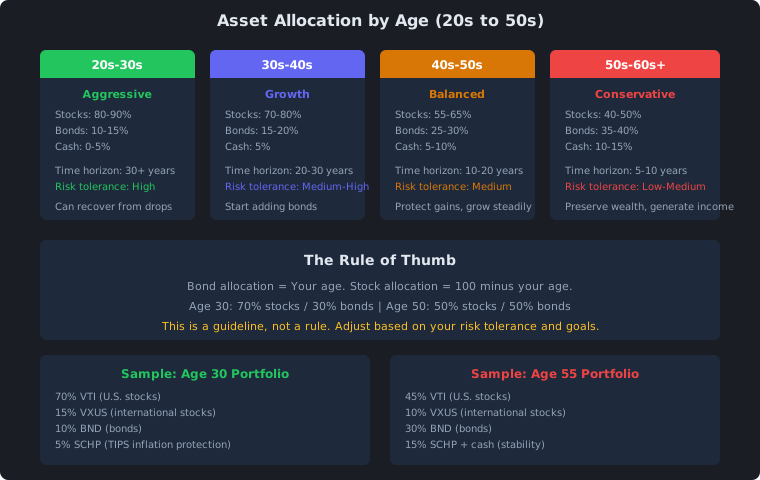
Before diving into detailed portfolios, it helps to have a quick mental model. A long-standing guideline says your bond allocation should roughly equal your age, with the rest in stocks — in other words, stocks at 100 minus your age. A slightly more modern variant pushes that to 110 minus your age, acknowledging that people are living longer and retiring later.
| Your age | Stocks | Bonds |
|---|---|---|
| 20 | 80% | 20% |
| 30 | 70% | 30% |
| 40 | 60% | 40% |
| 50 | 50% | 50% |
| 60 | 40% | 60% |
These figures are a starting point, not a commandment. Some people prefer to hold international stocks and inflation-linked bonds alongside the core split, and plenty of investors deliberately run more aggressive or more conservative than the table suggests. The point of the rule is simply to give you a defensible default before you start second-guessing yourself.
Your 20s and 30s: the aggressive years
In your 20s and 30s, you typically have 30 or more years until retirement. That long runway is your greatest asset: even if the market crashes hard, you have time on your side to keep contributing and let compounding rebuild your balance. The sensible approach here is to lean heavily into stocks.
At this stage a common allocation is roughly 80-90% stocks, 10-15% bonds and 0-5% cash. A sample portfolio for a 30-year-old might break down as 65% in a broad home-market tracker, 15% in international stocks, 15% in bonds and 5% in inflation-protected bonds. The expected long-run returns on such a growth-heavy mix typically land in the 10-12% range annually, but it is a bumpy ride: in a genuinely bad year you might see a 30-40% drawdown, with recovery historically taking somewhere in the region of three to five years.
The value of starting early cannot be overstated. Investing roughly $500 a month from age 25 to 65 at a 10% return works out to around $2.6 million; starting the same habit at 35 yields closer to $1.0 million. That ten-year head start is worth roughly $1.6 million — literally more than the contributions themselves.
Your 30s and 40s: growth with balance
As you move through your 30s and into your 40s, you are typically in your peak earning years. You still have 20 to 30 years until retirement, so stocks remain the engine of your portfolio, but it is now worth starting to protect some of the gains you have already banked.
A realistic allocation here is 70-80% stocks, 15-20% bonds and 5% cash. By age 40, a sample portfolio might hold around 55% in a home-market tracker, 15% in international stocks, 20% in bonds, 5% in property (through a REIT-style fund) and 5% in cash. Expected returns tend to sit in the 8-10% band, with maximum drawdowns in the 25-35% range and recovery times of two to four years.
The shift is subtle but meaningful: you are no longer trying to maximise growth at any cost, but rather to grow steadily while gradually insulating what you have built.
Your 40s and 50s: balanced growth
In your 40s and 50s, you are probably ten to twenty years from retirement, and protecting your accumulated wealth starts to matter as much as growing it. Your earning power is still strong, but you no longer have the same room to recover from a severe loss.
The target becomes 55-65% stocks, 25-30% bonds and 5-10% cash. A 50-year-old’s portfolio might hold around 45% in a home-market tracker, 10% in international stocks, 30% in bonds, 5% in property and 10% in cash. Expected returns typically drop to the 7-9% range, drawdowns to 20-25%, and recovery times to two to three years — a noticeably smoother ride than in your 20s.
Your 50s and beyond: conservative income
Within five to ten years of retirement, the priorities shift decisively. Capital preservation and income generation take over from outright growth, because you are about to start relying on this money rather than adding to it.
A sensible allocation in your 50s and 60s is 40-50% stocks, 35-40% bonds and 10-15% cash. A sample portfolio for someone aged 60 might be 35% in a home-market tracker, 10% in international stocks, 35% in bonds, 5% in inflation-linked bonds, 5% in property and 10% in cash. Expected returns fall to the 5-7% range, but drawdowns shrink to 15-20% and recovery typically takes just one to two years — the trade-off being lower risk rather than lower liveability at the point you need it most.
The glide path
Put the stages together and you get what fund managers call a glide path — the gradual shift in your mix as you age.
| Age | Stocks | Bonds | Cash | Phase |
|---|---|---|---|---|
| 25 | 90% | 10% | 0% | Maximum growth |
| 35 | 80% | 15% | 5% | Growth with balance |
| 45 | 70% | 25% | 5% | Balanced growth |
| 55 | 55% | 35% | 10% | Income preparation |
| 65 | 40% | 45% | 15% | Income and preservation |
If all of this sounds fiddly to manage yourself, that is precisely what target-date funds are for. These are single funds that hold a mix of stocks and bonds and automatically adjust it as your target retirement year approaches — the fund does the glide path for you, which makes them a genuinely hands-off solution for investors who prefer to set and forget.
How to implement it
You only really need three or four low-cost funds to build any of these portfolios. A broad home-market tracker gives you the core stock exposure, an international tracker adds global diversification, a bond fund provides stability, and an inflation-linked bond fund (plus a cash buffer) rounds things out. Picking individual funds is less important than setting the overall split and sticking to it.
Whatever you choose, commit to rebalancing roughly once a year. Market movements will quietly drift your percentages away from target — if stocks have grown to 70% when your target is 60%, sell a little and buy bonds back to your split. This discipline forces you to sell what has gone up and buy what has gone down, which is the opposite of the panicking most investors naturally do.
Two things matter more than any ratio. The first is to avoid being too aggressive near retirement — a market crash right before you need the money can force you to keep working longer than you planned. The second, and arguably the bigger trap, is being too conservative when you are young: a 25-year-old sitting entirely in bonds might earn 4% a year while stocks return 10%, and over forty years that gap can cost you the better part of a million pounds.
Bottom line
There is no single right allocation, but there is a sensible shape for every age. Start stock-heavy in your 20s and 30s, gradually add bonds and cash through your 40s, and arrive at retirement in a balanced, income-friendly portfolio. Pick a split you can actually hold through a rough year, implement it with a handful of cheap index funds, rebalance annually, and let time do the heavy lifting.