Having £10,000 to invest is a genuine milestone. It is also the moment most people make their first serious portfolio mistake: they put the lot into the market on a good day, panic when prices fall, and sell at the worst possible time. The good news is that the answer to “how do I invest £10,000 without losing money?” is not clever stock-picking or timing tricks — it is a dull, repeatable sequence of protective steps. Do them in order and you remove most of the ways money actually gets lost.
The plan below treats £10,000 as an illustrative sum — the same steps work for any lump sum. The structure is always the same: keep the downside impossible before you invest a penny, ease your way in rather than gambling on one day’s price, spread the money across several asset classes so nothing single can sink you, and then mostly leave it alone. Chasing the upside is only half the puzzle; protecting the downside is what actually keeps you invested long enough to win.
Why most people lose money (and it’s not the market)
Markets will always drop — that part is unavoidable. What is avoidable is your own reaction to it. The average investor earns historically less than the funds they own, roughly 4-5% a year against long-run market returns closer to 8-10%, precisely because they buy after a rally and sell after a fall. The fund never lost that money; the investor gave it away twice.
This matters because it reframes the entire problem. You do not need £10,000 to be safe from volatility — you need it to be safe from yourself. Every step in the plan that follows exists to remove a decision you might later regret: a buffer so you never sell in a crisis, gradual investing so you never wince at a single entry price, diversification so no one headline can undo you, and automation so you stop looking.
Step 1: Protect the downside before you touch the market
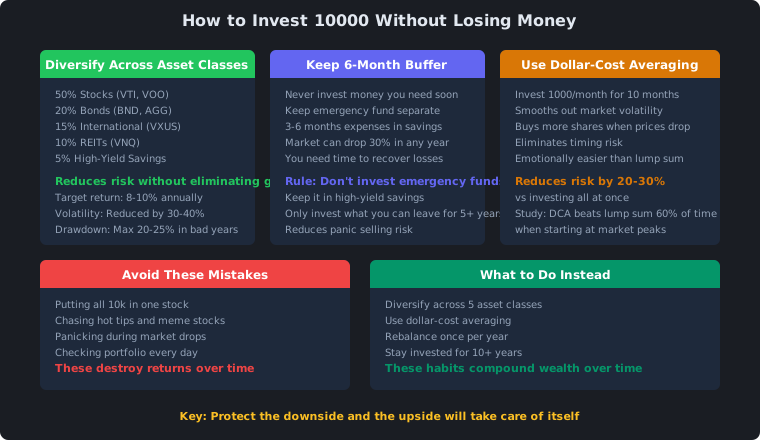
Before any of the £10,000 goes into stocks or bonds, set aside roughly six months of living expenses in an easy-access account. That is not “investing” — it is insurance. If you spend around £2,000 a month you need about £12,000; at £3,000 a month, £18,000; at £4,000, £24,000. Size it to your real costs, not a rule of thumb.
High-yield savings accounts are the natural home for this buffer. Names like Marcus (around 4.5%), Ally (around 4.4%) and Wealthfront (around 4.8%) are US examples of the kind of product that in the UK takes the form of easy-access savings accounts offered by any number of banks and building societies. The exact rate matters less than the qualities that make it succeed: the money must be liquid, government-backed up to your local deposit-protection limit, and boring enough that you never think about it.
There are two further gates before investing your £10,000. Clear any high-interest debt first — eliminating a credit-card balance that costs 15-25% a year is a better guaranteed return than the market’s most optimistic forecast. And only invest money you will not need within five years. If a house deposit or a wedding is on the £10,000’s horizon, it belongs in that buffer, not in the market. A 30% market drop is survivable if you have time; it is ruinous if that cash was already spent in your plans.
Step 2: Ease your way in — dollar-cost averaging
The natural instinct is to invest everything on day one. That is also, on average, where the money does slightly best: a well-known Vanguard study found that lump-sum investing beat dollar-cost averaging roughly 65% of the time, simply because markets trend upward and every day in cash is a day missed. We cover that research in more detail in our dollar-cost averaging vs lump sum guide.
So why not lump sum it? Because the other 35% of the time hurts a lot, and the emotional toll of investing everything the week before a crash is exactly what drives people to sell low. Dollar-cost averaging fixes that by removing the decision: you invest £1,000 a month for ten months, buying more shares when prices fall and fewer when they rise, smoothing your average entry price across the whole period. Psychologically it is the gentler ride — and a plan you can hold through a bad month beats a mathematically superior one you abandon. Pick a six-to-twelve-month schedule and automate it; the exact monthly figure is less important than the discipline.
Step 3: A diversified home for the money
Once the £10,000 is working, spread it across asset classes so no single downturn can define your year:
| Allocation | Asset Class | Example ETF | Historical expected return |
|---|---|---|---|
| 50% | US stocks | VTI | 10-12% |
| 20% | Bonds | BND or AGG | 3-5% |
| 15% | International stocks | VXUS | 8-10% |
| 10% | Real estate (REITs) | VNQ | 7-9% |
| 5% | Cash | High-yield savings | 4-5% |
Read the table as a single instrument, not five separate bets. The 50% in US stocks (a low-cost total-market fund like VTI) is the growth engine; the 20% in bonds (BND or AGG) softens crashes; the 15% in international stocks (VXUS) protects you from the US market being expensive or unlucky; the 10% in real estate (VNQ) adds an income-producing asset that behaves differently from shares; and the 5% cash is your ammunition for rebalancing. Together the blend has historically aimed at roughly 8-10% a year — with the honest warning that years in the 20-25% drawdown territory happen, and recovery from those typically takes two to three years. The tickers are US-listed; UK platforms sell the same strategy through global trackers and bond funds, so check what your broker offers rather than hunting specific symbols.
Step 4: Simpler still — the three-fund portfolio
If five funds feels like clutter, cut it to three: VTI at 60%, VXUS at 25% and BND at 15%. That single decision removes the US/international tilting problem entirely because the blend is standard and proven. Annual cost is under 0.1%, expected returns grade out around 8-9%, and the only maintenance is a yearly rebalance: if any position drifts more than five percentage points from target, sell the winners and top up the laggards back to 60/25/15. The rebalancing is what quietly makes the boring portfolio outperform the exciting one — it forces you to buy low and sell high on schedule.
What to avoid
The classic mistakes are all behavioural. Putting the whole £10,000 into a single stock, because one bad quarter can wipe out 30-50% of it. Chasing “meme” stocks or speculative ideas, which are gambling with a brokerage statement. Panic selling, which converts temporary setbacks into permanent ones. Checking the portfolio daily, which manufactures anxiety that ends in an impulsive trade. And skipping the emergency fund, which is how a car repair turns into a locked-in market loss. The fix for all five is one sentence: automate your contributions, rebalance once a year, and spend the other 364 days not looking.
What the numbers could look like
None of this is a forecast — it is a worked illustration. Invest your £10,000 in the diversified blend and earn a steady 8.5% a year, and the pot grows to roughly £10,850 after year one, £11,770 after year two, £12,770 after year three, £14,970 after five, £22,160 after ten and £48,380 after twenty years — without adding another penny.
Add £500 a month on top and the picture changes completely: around £110,000 by year ten, £340,000 by year twenty and £890,000 by year thirty. Not one of those outcomes requires skill, news-reading or timing. They require a buffer, an entry plan, a diversified allocation and the discipline to leave it alone. That is the entire secret.
Bottom line
You do not lose £10,000 by buying the wrong fund; you lose it by skipping the buffer, investing at the wrong moment, concentrating on one bet, or selling in panic. Fix each of those cheaply in advance and the money does almost all the work itself: accumulate six months of expenses first, dollar-cost average the lump in over about ten months, spread it across stocks, bonds, international and real estate, keep the fees under 0.1%, rebalance annually, and automate everything you can. Time in the market beats timing the market — and with the downside hedged before you start, you can finally let the upside take its course.