Auto Insurance: Full Coverage vs Liability — Which Do You Need?
June 16, 20263 min read
Key Takeaways
Liability-only coverage is the minimum legal requirement in most states.
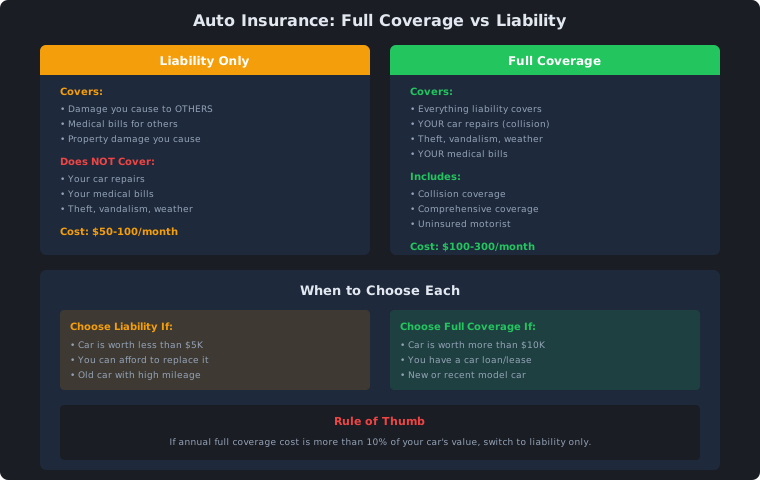
Full coverage (comprehensive + collision) protects your own vehicle from damage, theft, and accidents.
Drop full coverage when your car's value falls below 10x your annual premium — the math stops working.
Higher deductibles lower your premium but increase your out-of-pocket costs in an accident.
Compare the annual premium cost against your car's market value to decide if full coverage is worth it.
Most people pay too much for auto insurance because they don’t understand what they actually need. Here’s how to choose the right coverage and save money.
Full Coverage vs Liability
Factor
Liability Only
Full Coverage
Covers others’ damage
Yes
Yes
Covers your car
No
Yes
Covers theft
No
Yes
Covers weather damage
No
Yes
Monthly cost
$50-100
$100-300
When to Choose Liability Only
Situation
Why Liability
Car worth less than $5,000
Repair costs exceed car value
Can afford to replace it
Self-insure the risk
Old car, paid off
No loan requirement
Budget is tight
Save $600-2,400/year
When to Choose Full Coverage
Situation
Why Full Coverage
Car worth more than $10,000
Protects investment
Car loan or lease
Required by lender
New or recent model
Expensive to replace
Can’t afford to replace
Insurance is safer
The 10% Rule
If your annual full coverage cost is more than 10% of your car’s value, switch to liability:
Car Value
Max Full Coverage Cost
Switch at
$5,000
$500/year
Above $500
$10,000
$1,000/year
Above $1,000
$20,000
$2,000/year
Above $2,000
$30,000
$3,000/year
Above $3,000
Coverage Types Explained
Type
What It Covers
Required?
Liability
Damage you cause to others
Yes
Collision
Your car in an accident
If you have a loan
Comprehensive
Theft, weather, vandalism
If you have a loan
Uninsured motorist
Hit by uninsured driver
Varies by state
Medical payments
Your medical bills
Varies by state
How to Lower Your Premium
Strategy
Savings
Raise deductible
15-30%
Bundle with home
10-20%
Good driver discount
10-25%
Pay annually
5-10%
Shop around
20-40%
Good student
5-15%
Low mileage
5-10%
Common Mistakes
Mistake
Why It’s Wrong
Too much liability
You’re overpaying
Too little liability
Risky if you cause a big accident
Not bundling
Missing 10-20% discount
Never shopping around
Paying too much
Choosing low deductible
Higher premiums for no reason
Recommended Coverage by Situation
Situation
Liability
Collision
Comprehensive
Old car, paid off
50/100/50
No
No
Newer car, paid off
100/300/100
Yes
Yes
Car with loan
100/300/100
Yes (required)
Yes (required)
New car, financed
250/500/100
Yes
Yes
Quick decision guide
Key Point
Takeaway
Liability
Cheaper, covers others only
Full coverage
More expensive, covers your car too
10% rule
Switch when cost > 10% of car value
Shop around
Save 20-40%
Bundle
Save 10-20%
Raise deductible
Save 15-30%
Keeping your coverage current
Your auto insurance needs change as your car ages and your financial situation evolves. A policy that made sense when you bought a new car off the lot may no longer be the right fit once the vehicle has depreciated below $5,000. Review your coverage at every renewal, especially after paying off a loan — once the lender is no longer requiring collision and comprehensive, the decision becomes yours.
If you have improved your driving record, ask your insurer about a good driver discount. Many providers reward three to five years of claim-free driving with 10-25% reductions. Similarly, bundling your auto policy with home or renters insurance typically saves an additional 10-20%. Shopping around every one to two years remains the single most effective way to keep costs down, since rates for identical coverage can vary by $500-1,500 between insurers. The thirty minutes you spend comparing quotes online is, pound for pound, the easiest money you will save all year.
Frequently Asked Questions
What is the difference between liability and full coverage auto insurance?
Liability coverage pays for damage you cause to other people and their property. Full coverage adds collision and comprehensive coverage, which also pays to repair or replace your own vehicle after an accident, theft, or weather event.
When should I drop full coverage on my car?
A common guideline is to drop full coverage when your car's market value falls below 10 times your annual full coverage premium. At that point, the premium cost outweighs the potential payout.
How much can I save by raising my deductible?
Raising your deductible from $250 to $1,000 typically lowers your premium by 15-30%. Make sure you can comfortably pay the higher deductible out of pocket if you need to file a claim.
Does bundling auto and home insurance really save money?
Yes, most insurers offer a 10-20% discount when you bundle auto and home or renters insurance on the same policy. That typically saves $50-200 per year.
PP
PaisayehPaisa Editorial Team
Financial education in plain language. Our team reviews every article for accuracy and clarity.