The life insurance industry pushes whole life insurance because agents earn 10x more commission. But for 90% of people, term life is the smarter choice.
Here’s the math that proves it.
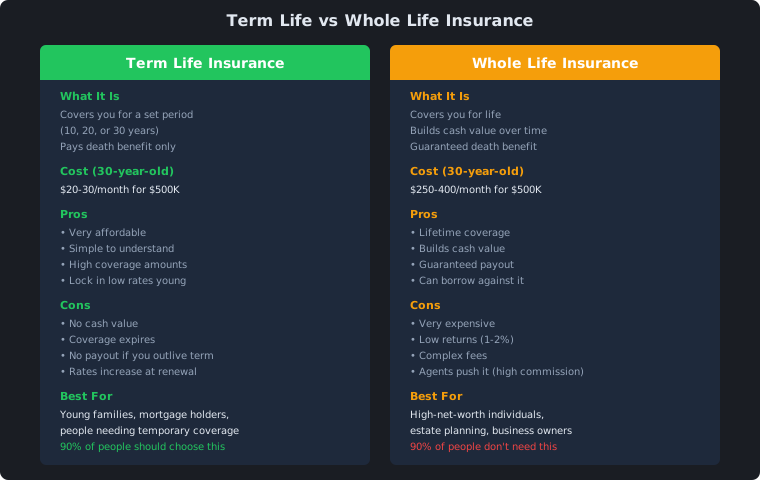
The Quick Comparison
| Factor | Term Life | Whole Life |
|---|---|---|
| Coverage period | 10, 20, or 30 years | Lifetime |
| Monthly cost | $20-40 | $250-400 |
| Cash value | None | Yes (1-2% return) |
| Death benefit | Guaranteed if you die in term | Guaranteed |
| Complexity | Simple | Complex |
| Agent commission | 50-70% first year | 50-110% first year |
The Cost Difference
For a 30-year-old, non-smoker, $500K coverage:
| Type | Monthly Cost | Annual Cost | 30-Year Total |
|---|---|---|---|
| Term (30-year) | $25 | $300 | $9,000 |
| Whole Life | $350 | $4,200 | $126,000 |
| Difference | $325/mo | $3,900/yr | $117,000 |
That $325/month difference invested in the S&P 500 at 10% = $750,000 after 30 years.
When Term Life Is Better (90% of People)
| Situation | Why Term |
|---|---|
| Young family | Need high coverage at low cost |
| Mortgage holder | Cover the mortgage duration |
| Income earner | Replace income for dependents |
| Budget-conscious | Affordable protection |
| Temporary need | Coverage until kids are grown |
When Whole Life Might Make Sense
| Situation | Why Whole Life |
|---|---|
| Estate planning | Wealth transfer for estates >$12M |
| Business succession | Buy-sell agreements |
| Special needs child | Lifetime care funding |
| Maxed out all retirement accounts | Tax-advantaged cash value |
| High-net-worth (>$5M) | Tax diversification |
The “Buy Term and Invest the Difference” Strategy
| Step | Action | Result |
|---|---|---|
| 1 | Buy 30-year term life ($500K) | $25/month |
| 2 | Invest $325/month in VTI | Compound growth |
| 3 | After 30 years | $750,000+ portfolio |
| 4 | Term expires | Self-insured with investments |
Real Example: 30-Year Comparison
| Year | Term + Invest | Whole Life Cash Value |
|---|---|---|
| 5 | $25,000 | $8,000 |
| 10 | $65,000 | $22,000 |
| 15 | $130,000 | $45,000 |
| 20 | $230,000 | $75,000 |
| 25 | $400,000 | $110,000 |
| 30 | $750,000 | $150,000 |
Winner: Term + invest the difference by $600,000
The comparison at a glance
| Key Point | Takeaway |
|---|---|
| For most people | Term life is better |
| Cost difference | 10-15x cheaper |
| Invest the difference | $750K+ vs $150K cash value |
| Whole life only for | Estate planning, high net worth |
| Don’t let agents upsell | They earn 10x more on whole life |
How to choose for your situation
The decision is rarely about the product — it is about your stage of life. If you have dependents who rely on your income, mortgages to repay, or children to support through education, term life gives you the coverage you need at a price you can actually sustain. The term length (10, 20, or 30 years) should line up with how long that need will last: until the mortgage is paid off, until the kids leave home, or until your partner becomes financially independent.
Whole life, in contrast, is built around permanence and cash value rather than affordable protection. If your goal is to pass wealth to the next generation while avoiding estate taxes, fund a buy-sell agreement, or provide for a special needs child for a lifetime, the guarantees of whole life can be worth the premium — but those are narrow, high-probability situations that few families actually face.
What to watch out for
The single biggest risk in this market is advice driven by commission rather than your needs. Because whole life pays an agent roughly ten times more than term, it is the product most commonly recommended — even when the buyer simply wants protection. The honest test is to ask what the coverage costs per $1,000 of protection and what happens if your circumstances change. A well-chosen term policy with the premium difference invested gives most families far more protection and wealth than a whole life policy ever would.
Frequently asked questions
Does term life build any cash value? No. Term life is pure protection — it pays out only if you die within the term, and has no cash value. That is why it is so much cheaper, and why the “buy term, invest the difference” strategy works.
Can I convert term life to whole life later? Many term policies offer a conversion option that lets you switch to permanent cover without a new medical exam, though the premium rises. It can be a useful feature if your health changes and you later need lifelong cover.
What if I outlive my term policy? The policy simply ends with no payout. That is fine if the need has passed (mortgage paid, children independent), because you can rely on the investments you built with the difference. If you still need cover, you can take out a new policy, though it will cost more at an older age.