HMO vs PPO Health Insurance: Which Plan Is Right for You?
June 16, 20263 min read
Key Takeaways
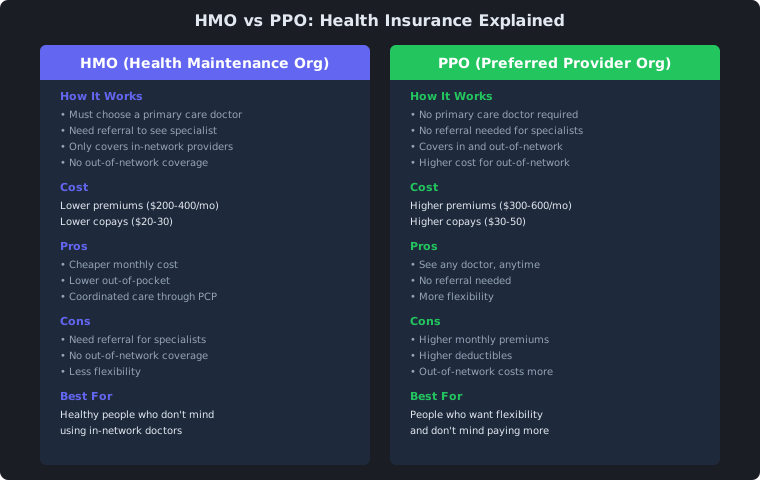
HMO plans have lower premiums (roughly $100-200 per month less) but require a primary care physician and referrals, with no out-of-network coverage.
PPO plans cost more but allow you to see any specialist without a referral and cover out-of-network care at a higher coinsurance rate.
For most healthy people who rarely need doctors, an HMO can save roughly $1,200-2,400 per year.
Choose PPO if you travel frequently, see many specialists, or want to keep a specific out-of-network doctor.
Choosing between HMO and PPO can save you hundreds of dollars per year. The right choice depends on whether you value low costs or flexibility.
Here’s the complete breakdown.
HMO vs PPO at a Glance
Factor
HMO
PPO
Monthly premium
$200-400
$300-600
Deductible
$500-1,500
$1,000-2,500
Copay
$20-30
$30-50
Out-of-network
Not covered
Covered (higher cost)
Referral needed
Yes
No
Primary care required
Yes
No
HMO: Health Maintenance Organization
How It Works
Choose a primary care physician (PCP)
Get referrals from PCP to see specialists
Only see in-network providers
No out-of-network coverage
Pros
Pro
Details
Lower premiums
$100-200 less per month
Lower copays
$20-30 per visit
Coordinated care
PCP manages your care
Lower out-of-pocket
Better cost protection
Cons
Con
Details
Need referrals
Can’t see specialists directly
In-network only
No coverage outside network
Less flexibility
Must stay in system
PCP gatekeeper
Extra step for specialists
PPO: Preferred Provider Organization
How It Works
No PCP required
See any specialist without referral
In-network and out-of-network covered
Higher costs for out-of-network
Pros
Pro
Details
No referrals
See specialists directly
Out-of-network coverage
Higher cost but covered
More flexibility
Choose any provider
No gatekeeper
Direct access to care
Cons
Con
Details
Higher premiums
$100-200 more per month
Higher copays
$30-50 per visit
Higher deductible
More upfront cost
Out-of-network costs
40-50% coinsurance
When to Choose HMO
Situation
Why HMO
Healthy, rarely see doctors
Lower premiums save money
Don’t mind your current doctors
Stay in-network
Want lower costs
Save $1,200-2,400/year
Prefer coordinated care
PCP manages referrals
When to Choose PPO
Situation
Why PPO
Travel frequently
Need out-of-network coverage
See many specialists
No referral delays
Want provider choice
See any doctor
Have a specific doctor
May be out-of-network
Real-World Cost Example
Healthy Person (2 doctor visits/year)
Plan
Annual Premium
Copays
Total
HMO
$3,600
$60
$3,660
PPO
$5,400
$100
$5,500
HMO saves
$1,840
Person with Chronic Condition (12 visits/year + specialist)
Plan
Annual Premium
Copays
Total
HMO
$3,600
$360
$3,960
PPO
$5,400
$600
$6,000
HMO saves
$2,040
Person Needing Out-of-Network Care
Plan
Annual Premium
Out-of-Network
Total
HMO
$3,600
$0 (not covered)
$3,600
PPO
$5,400
$2,000
$7,400
HMO cheaper
$3,800
Other Plan Types
Plan
How It Works
Best For
EPO
Like HMO but no referrals needed
Want HMO costs with more flexibility
POS
HMO + PPO hybrid
Moderate flexibility needs
HDHP
High deductible, lower premiums
Healthy, want HSA benefits
The decision at a glance
Key Point
HMO
PPO
Cost
Lower
Higher
Flexibility
Less
More
Referrals
Required
Not required
Out-of-network
Not covered
Covered
Best for
Healthy, budget-conscious
Travelers, specialist-heavy
How to choose with confidence
The decision comes down to a handful of personal circumstances rather than any universal rule, so work through them in order before comparing plans. First, check which doctors and hospitals you or your family already use — if they’re only in a PPO network, a lower-priced HMO saves little if you’d have to switch providers anyway. Second, count your expected specialist visits: someone managing a chronic condition or seeing several specialists may value the no-referral flexibility of a PPO more than the premium saving. Third, think about travel and location — if your job involves frequent out-of-state trips, an HMO’s lack of out-of-network coverage becomes a real gap, whereas a PPO follows you. Finally, take a sensible view of the premium gap, typically $100-200 per month: for a healthy person that’s a genuine saving approaching $1,200-2,400 a year, but it only counts if you actually stay in-network.
Common mistakes to avoid
The most avoidable error is choosing on premiums alone without checking whether your preferred doctors are in-network — a surprise out-of-network bill for a PPO’s 40-50% coinsurance can erase years of premium savings. Another is underestimating just how restrictive an HMO’s referral system can feel if a health issue arrives: needing a PCP’s referral for every specialist adds steps at exactly the worst time. At the other extreme, over-buying a PPO “just in case” you might want flexibility, then never using out-of-network care, leaves money on the table every month. And on an HDHP, some people skip care to avoid cost sharing, which quietly turns small problems into expensive ones. Match the plan to how you genuinely use healthcare, not to how you imagine you might one day.
Frequently asked questions
Should I switch from an HMO to a PPO just for a specific specialist?
Only if the specialist actually matters to you long-term. Confirm first that the specialist is genuinely covered by the PPO network — otherwise you’d pay higher premiums without gaining access. If it’s a single specialist you see rarely, an HMO plus an out-of-pocket self-pay visit can be cheaper than a year of PPO premiums.
How do I handle a bill for out-of-network care on a PPO?
Out-of-network providers don’t have negotiated rates with your insurer, so you may receive a “balance bill” for the difference between their charge and what the plan pays. With 40-50% coinsurance, that can be substantial, so get an estimate before elective care and check whether your plan offers access to a patient advocate or appeals process.
Are HSA-qualified HDHP plans available in either structure?
Yes. An HDHP can be structured as either an HMO or PPO, and what matters for the tax-free health savings account is that the deductible clears the annual IRS threshold. If you’re healthy and want the HSA tax benefit, you can often combine it with the lower-cost HMO network to control both premiums and exposure.
Final recommendation
For most healthy people who don’t travel much and don’t mind staying within a network, an HMO saves a meaningful amount every year — around $1,800 or more in the worked examples above — with little practical downside. If you travel frequently, see multiple specialists, or want to keep a specific out-of-network doctor, the PPO’s added flexibility justifies its higher premium. Price is only one input; whether your real-world providers are covered is what ultimately decides which plan protects you properly.
Frequently Asked Questions
What is the main difference between an HMO and a PPO?
An HMO requires you to choose a primary care physician and get referrals to see specialists, and it only covers in-network care. A PPO lets you see any specialist directly and covers out-of-network care, but with higher premiums, deductibles, and copays.
Can I see a specialist without a referral on a PPO?
Yes. PPO plans do not require a referral, so you can book a specialist directly. HMO plans require your primary care physician to refer you before coverage applies.
How much more expensive is a PPO than an HMO?
PPO premiums are typically $100-200 per month more than an HMO, and copays and deductibles are higher too. Over a year that can amount to $1,200-2,400 more for someone who rarely uses care.
Is an out-of-network claim ever covered by an HMO?
Generally no. HMOs offer no coverage outside their provider network except in genuine emergencies. A PPO covers out-of-network care, but typically at a higher coinsurance of around 40-50%.
PP
PaisayehPaisa Editorial Team
Financial education in plain language. Our team reviews every article for accuracy and clarity.