Auto insurance is mandatory in nearly every US state, across the UK, and throughout Canada. But the coverage options and costs vary significantly depending on where you live.
The Four Main Coverage Types
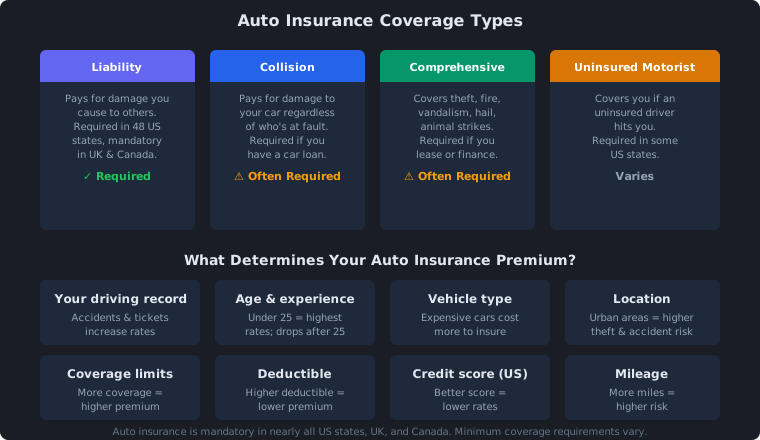
| Coverage | What it pays for | Required? |
|---|---|---|
| Liability | Damage you cause to others (property & injury) | Yes — in 48 US states, UK, Canada |
| Collision | Damage to your car regardless of fault | If you have a loan or lease |
| Comprehensive | Theft, fire, vandalism, weather, animal strikes | If you have a loan or lease |
| Uninsured Motorist | You if hit by someone without insurance | Required in some US states |
Minimum Coverage Requirements by Country
United States
Each state sets its own minimum liability limits, typically written as three numbers (e.g., 25/50/25):
- $25,000 bodily injury per person
- $50,000 bodily injury per accident
- $25,000 property damage per accident
New Hampshire and Virginia are the only states where car insurance is not mandatory, but you must prove financial responsibility.
Top insurers: State Farm, Geico, Progressive, Allstate, USAA (military only), Liberty Mutual
United Kingdom
UK law requires at least third-party insurance (liability), but most drivers choose comprehensive coverage.
- Third-party only (minimum legal requirement)
- Third-party, fire & theft
- Comprehensive (most common)
Top insurers: Admiral, Direct Line, Aviva, LV=, Hastings Direct
Canada
Each province has its own system:
| Province | System | Public or Private |
|---|---|---|
| British Columbia | ICBC | Public |
| Saskatchewan | SGI | Public |
| Manitoba | MPI | Public |
| Quebec | Hybrid | Public (injury) + private (damage) |
| Ontario & others | Private market | Fully private |
Top private insurers: Intact Insurance, TD Insurance, Desjardins, Aviva Canada, Co-operators
What Affects Your Premium
| Factor | Impact |
|---|---|
| Driving record | One at-fault accident can raise rates 30–50% |
| Age | Under 25 pays 2x what a 40-year-old pays |
| Location | Urban drivers pay 30–50% more than rural |
| Vehicle | A Tesla costs 2x to insure than a Honda Civic |
| Deductible | Raising from $500 to $1,000 can save 15–20% |
| Credit score (US only) | Poor credit can increase rates by 50%+ |
| Annual mileage | 15,000 miles/year costs more than 5,000 |
How to Save Money
| Strategy | Typical Savings |
|---|---|
| Bundle home & auto | 10–25% |
| Increase deductible | 15–30% |
| Pay annually vs monthly | 5–10% |
| Take a defensive driving course | 5–15% |
| Install anti-theft device | 5–15% |
| Ask about low-mileage discount | 10–20% |
| Shop around every renewal | 20–40% |
How Claims Work
- Report the accident — call your insurer immediately
- Provide evidence — photos, police report, other driver’s info
- Pay your deductible — you pay this first, insurer covers the rest
- Insurer assesses damage — they may send an adjuster or ask for repair estimates
- Repair or payout — insurer pays the repair shop or sends you a cheque
Claims statistics (US):
- Average annual claim frequency: 1 claim every 10–12 years per driver
- Average collision claim: ~$4,000
- Average comprehensive claim: ~$2,000
Real-World Examples
| Profile | Location | Monthly Premium | Coverage |
|---|---|---|---|
| 25-year-old, clean record, Honda Civic | Texas, US | ~$140 | Liability + collision |
| 40-year-old, clean record, BMW 3 Series | London, UK | ~£65 | Comprehensive |
| 30-year-old, one ticket, Toyota Camry | Ontario, Canada | ~$120 CAD | Full coverage |
| 55-year-old, clean record, Ford F-150 | Florida, US | ~$110 | Liability only |
What It All Adds Up To
| Key Point | What It Means For You |
|---|---|
| Liability is mandatory | Minimum coverage varies by state/province |
| Full coverage = liability + collision + comprehensive | Required if financing a car |
| Premium factors | Age, driving record, location, vehicle, deductible |
| Shop around | Rates vary by 40%+ between insurers for the same driver |
| Higher deductible saves money | Just make sure you can afford it if you need to claim |
What to Avoid
A few recurring mistakes separate smart buyers from those who overpay or end up dangerously under-covered:
Choosing the cheapest policy without checking the cover. Saving a few pounds or dollars on a bare-bones policy can backfire if it leaves you without breakdown cover, courtesy cars, or adequate liability limits. Compare like-for-like quotes rather than headline prices.
Dropping cover you still need. Once a car is old enough to be worth little, many people sensibly drop collision and comprehensive. But removing liability cover is never a good idea, because the damage you could cause to others is far larger than your own car’s value.
Setting a deductible you cannot afford. A very high deductible can slash your premium, but only if you have the money to hand when you need to claim. Choose a level you could realistically pay tomorrow without hardship.
Ignoring the impact of small claims. As the callout above explains, filing for a modest repair can cost you far more in raised premiums than you recover. A good rule of thumb is to only claim for significant damage.
Letting the policy auto-renew. Insurers rely on inertia, and loyalty rarely pays. A fifteen-minute comparison ahead of each renewal is the single most reliable way to cut your bill.
Common Questions
How much cover is enough? There is no single answer, but a sensible starting point is more than the legal minimum. Because third-party injury claims can run to six figures, buying higher liability limits than the state floor is usually worth the modest extra premium, especially if you have assets to protect.
What if I drive occasionally or very little? Many insurers offer pay-per-mile or low-mileage policies that can cut costs noticeably. Just be honest about your annual mileage, because underestimating it risks a reduced payout if you need to claim.
Does my credit score affect my premium? In the US, yes. A poor credit score can increase rates by 50% or more, and improving it over time is one of the more underrated ways to lower your bill. This factor does not apply in most other countries, where pricing is more tightly regulated.
What should I do straight after an accident? Stay calm, check everyone is safe, exchange details, take photos, and report the incident to your insurer promptly. Cooperate with the claim investigation and only authorise repairs once the insurer has assessed the damage.