If you own a home, your mortgage lender requires homeowners insurance. If you rent, your landlord likely requires renters insurance. But even if no one forced you, both are worth having.
Homeowners Insurance
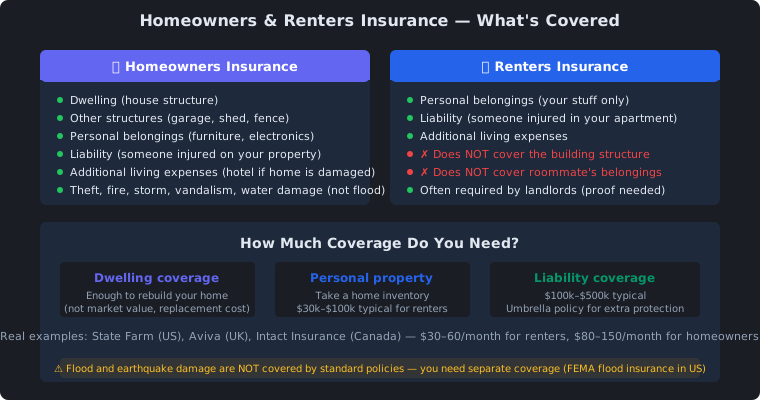
A standard homeowners policy (HO-3 in the US) covers six main things:
| Coverage | What It Protects |
|---|---|
| Dwelling | The house structure itself |
| Other structures | Garage, shed, fence, detached workshop |
| Personal property | Furniture, electronics, clothing, appliances |
| Loss of use | Hotel & meals if your home is uninhabitable |
| Liability | If someone is injured on your property |
| Medical payments | Minor injuries to guests (no lawsuit needed) |
What’s NOT covered by standard policies:
- Flood damage (need separate FEMA flood insurance in US)
- Earthquake damage (separate policy or rider)
- Routine maintenance (leaky pipes, mold from neglect)
- Sewer backup (can add as an endorsement)
- High-value items beyond limits (jewelry, art — need a rider)
Renters Insurance
Renters insurance is often overlooked, but it’s inexpensive and critically important.
| What it covers | What it doesn’t cover |
|---|---|
| Your personal belongings | The building structure (landlord’s insurance covers this) |
| Liability (someone hurt in your unit) | Roommate’s belongings |
| Additional living expenses | Flood or earthquake damage |
| Theft (even outside your home) | Intentional damage |
Average cost: $15–30/month for $30,000–$60,000 of personal property coverage.
How Much Dwelling Coverage Do You Need?
Your dwelling coverage should be based on replacement cost — how much it would cost to rebuild your home — not the market value.
| Home value | Market value includes | Replacement cost is |
|---|---|---|
| $400,000 | Land ($100k) + house ($300k) | ~$300,000 to rebuild |
| $200,000 (deprecated area) | Land ($100k) + house ($100k) | ~$300,000 to rebuild |
How Personal Property Coverage Works
Take a home inventory. Most people underestimate what they own.
Quick estimate (2-bedroom apartment):
- Furniture: $10,000–$20,000
- Electronics: $3,000–$8,000
- Clothing: $5,000–$15,000
- Kitchen: $2,000–$5,000
- Miscellaneous: $3,000–$8,000
Total: $23,000–$56,000
Renters insurance typically includes $30,000–$60,000 of personal property coverage. Increase it if you have more valuable belongings.
Real-World Examples by Country
United States
| Insurer | Homeowners (annual) | Renters (annual) |
|---|---|---|
| State Farm | $1,200 | $180 |
| Allstate | $1,350 | $200 |
| Liberty Mutual | $1,100 | $160 |
| USAA (military) | $950 | $140 |
Tip: Flood insurance through FEMA’s NFIP averages $700/year but varies by flood zone.
United Kingdom
Buildings insurance (structure) and contents insurance (belongings) are typically sold separately.
| Insurer | Buildings (annual) | Contents (annual) |
|---|---|---|
| Aviva | £200–£400 | £80–£150 |
| Direct Line | £180–£350 | £70–£130 |
| LV= | £190–£380 | £75–£140 |
Canada
| Province | Typical Homeowners (annual) | Typical Renters (annual) |
|---|---|---|
| Ontario | $1,200–$1,800 | $200–$350 |
| British Columbia | $1,000–$1,500 | $180–$300 |
| Alberta | $1,100–$1,700 | $190–$320 |
Top insurers: Intact Insurance, TD Insurance, Desjardins, Aviva Canada, Co-operators
Bundling Discounts
Most insurers offer significant discounts if you bundle home and auto insurance:
| Insurer | Bundle Discount |
|---|---|
| State Farm | 15–25% |
| Geico | 10–20% |
| Aviva | 15–25% |
| TD Insurance | 10–15% |
| Intact | 15–20% |
How to Save Money
| Strategy | Savings |
|---|---|
| Bundle home + auto | 10–25% |
| Increase deductible ($500 → $2,500) | 15–30% |
| Install security system | 5–15% |
| Pay annually | 5–10% |
| Maintain good credit (US) | 10–20% |
| Stay with same insurer (loyalty discount) | 5–10% |
| Shop around at renewal | 15–40% |
How to File a Home Insurance Claim
- Document the damage — take photos and videos before cleaning up
- Mitigate further damage — cover broken windows, tarp a leaking roof (insurer requires this)
- Contact your insurer — most have 24/7 claims lines
- Meet the adjuster — they’ll inspect the damage and estimate repair costs
- Receive payment — actual cash value (depreciated) or replacement cost (new), depending on your policy
What to review each year
| Item | Takeaway |
|---|---|
| Homeowners covers structure + contents + liability | Mortgage lenders require it |
| Renters covers contents + liability only | $15–30/month — worth it for everyone |
| Flood and earthquake are separate | Standard policies exclude them |
| Insure for replacement cost, not market value | Rebuilding costs are different from buying |
| Bundle to save | Home + auto bundle saves 10–25% |
| Review coverage annually | Your home’s value and your belongings change |
Common mistakes renters and owners make
The most frequent error is confusing market value with replacement cost. Your house might sell for $400,000, but if the land alone is worth $100,000, rebuilding the structure likely costs only around $300,000. Insuring the full market figure overpays, while insuring based on a careless estimate can leave you underinsured if the worst happens.
A second mistake is skipping the annual review. Your belongings grow, inflation pushes rebuild costs up, and you may have bought jewellery, art, or electronics that exceed the single-article limit on a standard policy. Without a yearly check — and a video inventory — a claim can fall short of what you actually own.
Frequently asked questions
Do I need renters insurance if I have nothing valuable? Yes. The liability protection is the main reason, and it costs only $15-30 a month. If a guest is injured in your flat or you accidentally cause a fire that damages the building, renters insurance protects you against costs that would otherwise come entirely from your own pocket.
Is flood insurance worth adding? It depends on where you live. Flood damage is not covered by a standard policy, and FEMA flood insurance averages around $700 a year but varies by flood zone. If you are in an area with any flood risk, the cost is typically far smaller than the potential loss.
When should I switch insurers? Review at every renewal. Loyalty discounts and shopping around can save 15-40%, so comparing quotes annually — while keeping sufficient cover — is usually the cheapest way to stay protected.