You do not have to take big risks to earn decent returns. For most of the 2010s that was genuinely true — safe money earned almost nothing, and investors were told to accept it. The rate environment of the mid-2020s is different: several low-risk options are paying roughly 4-5%, which means the old trade-off between safety and return has softened. This guide ranks the genuinely safe options — government-backed securities, deposit-protected savings, fixed-term deposits, inflation-linked bonds and money market funds — so you can earn a respectable rate and still sleep at night.
Two definitions up front. “Safe” here means the return is backed by something with real capital behind it — a government, or a deposit-protection scheme — rather than by a company’s fortunes or the price of a token. And the figures below are illustrative of the mid-2020s environment, not guarantees for 2026: rates move, and the point is the structure of the trade-offs, which stays the same in every environment. The products described are mostly American examples of universal ideas, and each has a close UK (and local) equivalent.
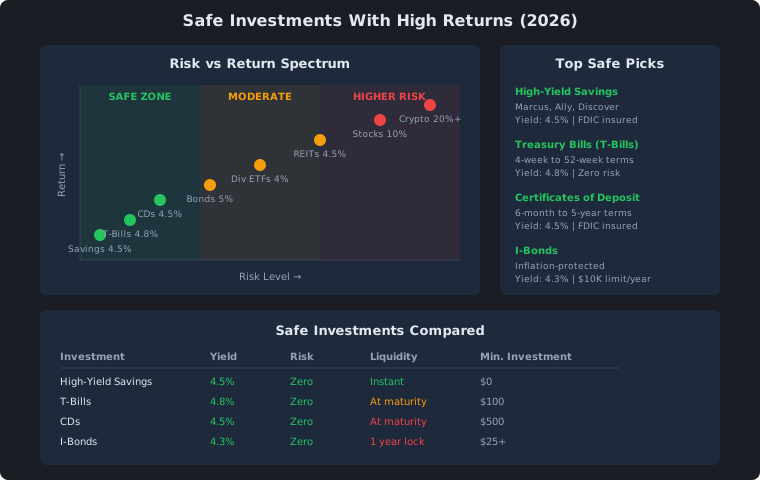
The safe investment universe, ranked by yield
1. Short-term government debt — around 4.8%. U.S. Treasury bills (T-Bills) are short-term loans to the U.S. government, running from four to 52 weeks, and they carry no default risk because the full faith of the government sits behind them. In mid-2026 the various terms were paying roughly 4.5-4.8% (13-week bills around 4.8%, 4-week around 4.6%). Buy them directly via TreasuryDirect in the US, or through any broker; the UK equivalent is buying short-dated gilts. The mechanics are worth knowing: you buy the bill at a discount — roughly $952 for a bill that pays $1,000 at maturity — and the difference is your interest, paid when it matures. No coupon, no drama, no chance of losing your capital unless the U.S. government defaults, which markets treat as a national hypothetical.
2. High-interest savings — around 4.5%. The best online savings accounts have been paying roughly 4.3-4.8%, well ahead of the high-street average. Marcus by Goldman Sachs (around 4.5%), Ally Bank (around 4.45%), Discover (around 4.40%), Capital One 360 (around 4.35%) and American Express (around 4.30%) all traditionally lead the pack in the US, each with no minimum balances and no monthly fees. In the UK the same role is played by easy-access savings accounts from any number of banks and building societies. The safety is structural: US deposits are protected by the FDIC up to $250,000 per depositor per bank, and UK deposits by the FSCS up to £85,000 — so within those limits, your money cannot vanish if the bank fails. This is the natural home for your emergency fund and any cash you might need within a year.
3. Fixed-term deposits — around 4.5%. A certificate of deposit (in the US) or a fixed-rate savings bond (in the UK) is a deposit with a guaranteed rate locked in for a set term, in exchange for you giving up access until maturity. Terms and typical mid-2020s rates looked like six months at 4.50%, twelve months at 4.40%, eighteen months at 4.30%, two years at 4.20% and five years at 4.00% — with early-withdrawal penalties of roughly one to four months’ interest depending on length. The single smartest way to use them is a ladder: split the money roughly 25% each across the six, twelve, eighteen and twenty-four-month terms, and as each matures, reinvest it at the longest available term. You average a higher rate than any single short deposit while always having a portion of the money within a few months of becoming available. If you might need the money at any point in the next couple of years, a ladder beats both pure cash and a locked single term.
4. Inflation-linked savings bonds — around 4.3%. US Series I savings bonds (I-Bonds) are government bonds whose interest combines a fixed rate with an inflation adjustment, so your money keeps its purchasing power rather than quietly eroding. They paid roughly 4.3% as a composite rate in mid-2026, require a minimum of $25, are capped at about $10,000 per person per year, and come with genuine friction: a one-year minimum lock-up, and three months’ interest forfeited if you redeem before five years. They are aimed at long-term savings and inflation hedging rather than at money you might need soon. The UK analogue is index-linked savings from NS&I, which work on the same principle of inflation plus a guaranteed margin. If you fear inflation more than you fear lock-ups, this is the option for you.
5. Money market funds — around 4.2%. A money market fund holds ultra-short, ultra-safe debt — government bills, bank deposits, top-rated commercial paper — and passes the interest through to you, usually with the ability to withdraw on a day’s notice. Vanguard’s VMFXX (around 4.25%, 0.11% fee), Fidelity’s SPAXX (around 4.20%, 0.42%) and Schwab’s SWVXX (around 4.15%, 0.34%) are the familiar US options, and UCITS money market funds do the same in Europe and the UK. They are not deposit-protected, strictly speaking, but because their holdings are short and government-backed, they historically move with the central bank rate and effectively never lose money in practice. They suit larger cash balances — £10,000 and up — where you want near-savings safety with rates that track the market up and down.
Choosing the right one for your situation
| Your situation | Best option |
|---|---|
| Need instant access | High-interest savings |
| Money free for 6-12 months | Short-term government debt |
| Want a guaranteed rate | Fixed-term deposits |
| Worried about inflation | Inflation-linked bonds |
| £10,000+ of cash to manage | Money market fund |
| Building an emergency fund | High-interest savings |
Reading the table is really a single question: how long can this money stay untouched? Emergency fund and within-a-year money belongs in instant-access savings. Six to twelve months buys you the slightly higher rate of short-term government debt. A year or more of certainty justifies fixed-term deposits, and a ladder captures their best rates without surrendering all flexibility. Inflation fear, across any horizon, points to inflation-linked bonds. And portfolios of cash too large to ignore — the money market fund row — are best managed in a product that tracks the central bank rate rather than letting a stale savings rate quietly fall behind.
A balanced “safe stack”
For a lump sum you want protected but producing, a blended approach between roughly £10,000 and £50,000 might look like 40% in high-interest savings, 25% in short-term government debt, 20% in laddered fixed-term deposits, 10% in inflation-linked bonds and 5% in a money market fund. Blended together across the mid-2020s rates above, that stack lands around 4.3-4.5% overall — not thrilling, but genuinely safe, fully liquid at some point within a year, and structured so that inflation-protected and fixed-rate pieces each do a distinct job. No single choice has to be perfect; the blend is what makes the whole thing resilient.
What is not safe (no matter what it promises)
It is worth naming the danger zone explicitly. Crypto stablecoins are not deposit-protected and carry counterparty risk their marketing rarely mentions. Corporate bond funds can lose value when rates rise, because the price of the bonds moves against you even though the coupons keep coming. “High-yield” accounts from unfamiliar banks may not carry deposit protection at all. Annuities are often safe but complex, expensive and deeply illiquid, hiding their costs in the fine print. And anything promising 10% or more “with no risk” is not a safe investment-it is a red flag, and frequently a scam. The rule that ties it together: genuinely safe yield in a normal rate environment lives in the 4-5% band, and every extra percentage point above it is a price you will pay in risk, fees or liquidity. There is no exception.
Bottom line
Safe money does not have to earn nothing anymore, but it should never pretend to be something it is not. Match your cash to its horizon — instant-access savings for emergencies, short-term government debt for six to twelve months, laddered fixed-term deposits for guaranteed rates, inflation-linked bonds for purchasing-power protection, and money market funds for larger balances — and build a stack that blends three or four of them rather than betting everything on one product. The safety is in the backing: government guarantees and deposit protection, not marketing. Earn your 4-5%, keep every penny reachable on your own timetable, and let the people promising 10% “risk-free” knock on someone else’s door.