Investing your first £1,000 is less about the money and more about the habit you are starting. It is enough to be genuinely diversified, to test whether you can hold positions through a bad week, and to begin the compounding that does the real work over decades. But where exactly should £1,000 go? There is no single right answer, because the best home depends on what the money is for and when you will need it. The five options below are ranked from lowest risk to highest reward — and once you know your timeline, the choice largely makes itself.
Treat the figures as illustrative of the mid-2020s rate environment rather than a promise, and read the tickers for what they are: widely used US funds whose UK equivalents are available on any major platform. The £1,000 is used here for convenience — the logic works for £100 or £10,000 identically.
Option 1: High-yield savings (safest)
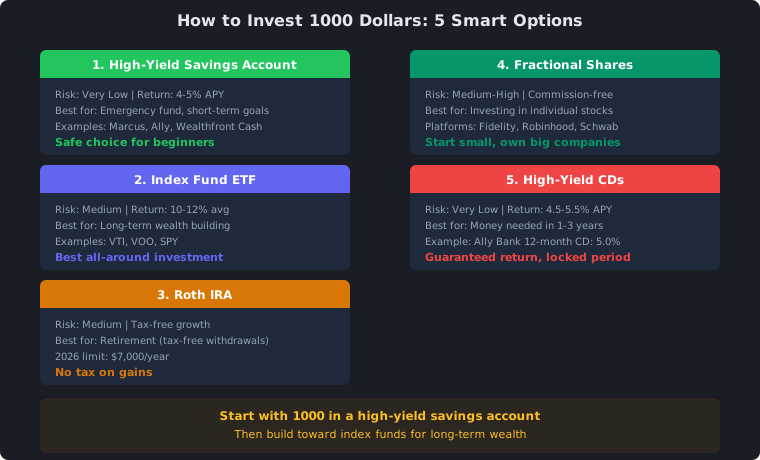
If you might need the money within a year, it is not investment money at all — it is savings with a growth problem. High-yield savings accounts pay roughly 4-5% with no risk to your capital and instant access, which makes them ideal for emergency funds and short-term goals. Names like Marcus (around 4.5%), Ally (around 4.4%) and Wealthfront Cash (around 4.8%) are the US standard-bearers; UK banks and building societies offer the same concept through easy-access savings accounts, typically with the equivalent local deposit-protection cover. Your £1,000 growing to roughly £1,040-1,050 in a year is modest, but it is guaranteed in a way no market return is. The moment the timeline stretches past a year or two, you are paying for that safety in foregone growth.
Option 2: Index fund ETFs (best all-rounder)
This is the option most people will land on first. An index fund or ETF gives you a slice of the whole market in one holding, which is the cheapest way to buy diversification — no stock-picking, no worrying about which company wins. On US-accessible platforms the usual starting points are VTI (the entire US market, historically around 11.7% average annual return, fee 0.03%) and VOO (the S&P 500’s 500 largest companies, around 12.3% average, fee 0.03%). The fees are the quiet hero here: paying a fraction of a percent a year, rather than 1% or more, keeps decades of compounding working for you instead of the fund provider.
What does that mean in money? Historically, £1,000 in the S&P 500 growing at the kind of double-digit averages these funds have shown would reach roughly £3,900 in ten years — with the honest caveat that those returns were far from smooth, and past performance is exactly that. Add a discipline of £100 a month and the same illustrative maths points to £18,000-plus over that decade. The return numbers on this kind of fund are why we treat them as the default; our guide to the best ETFs and our index funds primer go deeper if you want the details first.
Option 3: A tax-advantaged account (the hidden accelerator)
Investing inside the right wrapper is the closest thing to free money. In the US, a Roth IRA lets around $7,000 a year (the 2026 limit) grow and be withdrawn tax-free in retirement, and a 401(k) does the same with employer match potentially on top; in the UK the equivalent wrappers are the ISA (tax-free growth for any investment, within your annual allowance) and the SIPP (a pension that benefits from tax relief on contributions). The mechanics and limits differ in every country, so check the current rules where you live — the principle is universal: if your money can grow without the taxman taking a cut, it is worth packaging it that way.
The compounding advantage is enormous even on £1,000. Invest that amount yearly for thirty years at a 10% return and you accumulate a pot of roughly £172,000; the difference between that pot growing inside a tax-sheltered wrapper and outside one is the entire tax bill on its gains. In practice, the strongest version of this option is £1,000 of index fund inside a tax-advantaged account — combining Option 2’s diversification with Option 3’s tax treatment. If you invest anything this year, make it this.
Option 4: Fractional shares (own the giants with small money)
A share of a mega-cap company can cost hundreds of pounds, but fractional shares let you buy a slice instead of the whole thing: £100 of Apple rather than a single share, £50 of Amazon rather than one. You build a small, diversified basket of the companies you actually believe in, with £1 a share minimums on most modern platforms. The catch is that owning a handful of individual stocks is not the same as owning the market — a bad quarter from any one of them directly hits you, which is why this option carries medium-to-high risk.
A sensible £1,000 spread might look like this: £150 into Apple, £150 into Microsoft, £100 into Amazon, £100 into NVIDIA, £100 into Berkshire Hathaway, and the remaining £400 in a broad ETF like VTI as the anchoring position. Notice what that does: the ETF provides the ballast of hundreds of companies, while the five individual names give you the thrill of ownership without staking everything on them. If you do hold individual stocks, buy on dips rarely, and remember that no single company deserves the loyalty that used to be reserved for railway shares.
Option 5: Fixed-term deposits (guaranteed, if you can wait)
For money you know you will not need for one to five years, a fixed-term deposit — a CD in the US, a fixed-rate savings bond in the UK — locks in a guaranteed rate of roughly 4.5-5.5% in exchange for giving up access until maturity. The rates often beat easy-access savings because you are paying for the bank’s certainty with your liquidity. A simple ladder smooths out the trade-off: put around £200 into a six-month term, £300 into a twelve-month term and £500 into an eighteen-month term, then reinvest each rung as it matures at whatever current rates look like. You never lock everything in at one rate, and a portion of the money is always within a few months of becoming available.
Which option is yours?
The decision is really three questions posed in order. Is the money needed within the year, or does it belong in your emergency fund? Then it is savings — Option 1. Is it guaranteed to be untouched for five-plus years and available to a tax-advantaged account? Then Options 2 and 3 together are hard to beat. Is the money a genuine long-term holding but you want the fun and specific exposure of owning individual names, or a short-ish commitment you want guaranteed? Then look at Option 4 or 5. The one genuinely bad answer is holding money that belongs in savings inside a volatile index fund, or leaving money meant for growth parked in cash out of fear — pick the option matching your timeline, and let consistency do the rest.
Bottom line
£1,000 is a seed, not a fortune — but it is enough to establish the two habits that actually build wealth: automatic, regular investing, and leaving money on a ten-year horizon before you touch it. Put it in a broad index fund inside a tax-advantaged account if you can, use fractional shares to scratch the stock-picking itch without going all-in, keep any short-term money in savings or fixed-term deposits, and pay off high-interest debt before any of it. The best investment on this list is the one you actually start today — the second best is the one you add to next month.