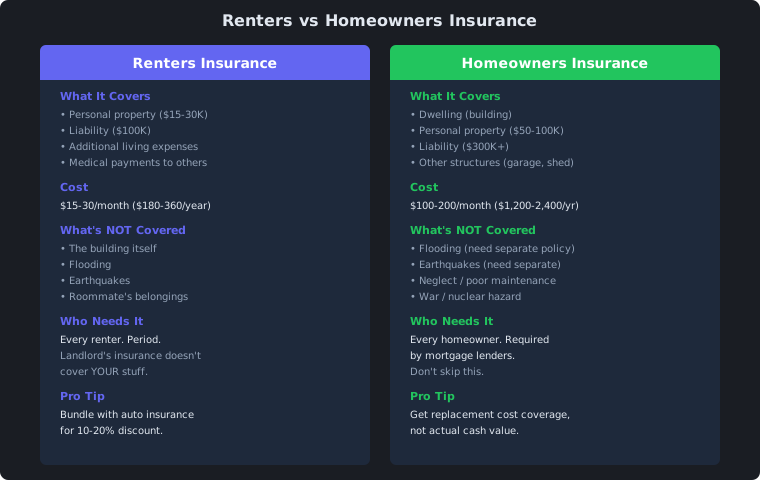
Your landlord's insurance covers the building, not your belongings — without renters insurance, a fire or theft leaves you with a total loss.
Renters insurance typically costs $15-30 per month and covers personal property, liability, and additional living expenses.
Homeowners insurance is required by mortgage lenders and covers both the dwelling and personal property, typically costing $100-200 per month.
Neither standard renters nor homeowners policies cover flooding or earthquakes — both require separate policies.
Bundling auto and home or renters insurance with the same provider typically saves 10-20% on premiums.
Your landlord’s insurance doesn’t cover your stuff. If there’s a fire, theft, or flood, your laptop, furniture, and clothes are gone — unless you have renters insurance.
Here’s what each policy covers and why you need it.
Quick Comparison
Factor
Renters Insurance
Homeowners Insurance
Covers
Your stuff only
Building + your stuff
Cost
$15-30/month
$100-200/month
Liability
$100K
$300K+
Building coverage
No
Yes
Required by
Some landlords
Mortgage lenders
What Renters Insurance Covers
Covered
Not Covered
Theft of personal property
The building itself
Fire damage to belongings
Flooding (separate policy)
Water damage (burst pipe)
Earthquakes (separate)
Liability (someone hurt in your apt)
Roommate’s belongings
Additional living expenses
Your car
Medical payments to others
Flood damage
Personal property limit: $15,000-$30,000 (increase if needed)
What Homeowners Insurance Covers
Covered
Not Covered
Dwelling (the building)
Flooding (separate policy)
Personal property ($50-100K)
Earthquakes (separate)
Other structures (garage, shed)
Neglect/poor maintenance
Liability ($300K+)
War/nuclear hazard
Additional living expenses
Your car
Medical payments to others
Foundation issues
Real-World Scenarios
Scenario 1: Apartment Fire
Without Renters
With Renters
Lost: $20K in belongings
Lost: $20K in belongings
Insurance pays: $0
Insurance pays: $20K
Hotel costs: $3,000 out of pocket
Hotel costs: $3,000 paid
Total loss: $23,000
Total loss: $0
Scenario 2: Kitchen Fire Destroys Home
Without Homeowners
With Homeowners
Building damage: $200K
Building damage: $200K
Insurance pays: $0
Insurance pays: $200K
Contents: $50K lost
Contents: $50K paid
Total loss: $250K
Total loss: $0
How Much Coverage Do You Need
Renters
Item
Coverage Needed
Electronics
$3,000-5,000
Furniture
$3,000-5,000
Clothing
$2,000-5,000
Jewelry
$1,000-2,000
Other items
$2,000-5,000
Total recommended
$20,000-25,000
Homeowners
Item
Coverage Needed
Dwelling
Replacement cost of home
Personal property
50-70% of dwelling coverage
Liability
$300K minimum
Deductible
$1,000-2,500
Cost Comparison
Policy Type
Monthly Cost
Annual Cost
Renters (basic)
$15
$180
Renters (good coverage)
$25
$300
Homeowners (basic)
$100
$1,200
Homeowners (good coverage)
$150
$1,800
Common Mistakes
Mistake
Consequence
Skipping renters insurance
$20K+ loss if theft/fire
Underinsuring home
Can’t rebuild after disaster
Not updating policy
Coverage gaps
Ignoring flood insurance
Not covered by standard policy
Choosing wrong deductible
Can’t afford $2,500 deductible
Key points at a glance
Key Point
Takeaway
Renters insurance
$15-30/month, protects your stuff
Homeowners insurance
$100-200/month, required by lenders
Both exclude
Flooding and earthquakes
Bundle
Auto + home/renters = discount
Don’t skip
One fire can cost $20K+
Getting the right policy today
Start by calculating what your belongings are actually worth. Walk through each room and add up the replacement cost of everything you own — electronics, furniture, clothing, kitchenware, books, and personal items. Most renters underestimate by 30-50%, and a typical recommendation is $20,000-25,000 in personal property coverage. For homeowners, the dwelling coverage should reflect the rebuild cost of your home, not its market value, and personal property coverage is typically set at 50-70% of the dwelling amount.
Shop around before committing. Get at least three quotes from different providers — rates for identical coverage can vary significantly. Ask about bundling discounts if you already have auto insurance, since combining policies typically saves 10-20%. Read the policy wording, particularly the exclusions: standard policies do not cover flooding or earthquakes, so if you live in a flood-prone area or earthquake zone, you will need a separate policy for those risks. Set your deductible at a level you can comfortably pay out of pocket — a higher deductible lowers your premium but means more cost when you file a claim.
Keeping your coverage current
Your insurance needs change over time, and your policy should keep pace. If you buy new electronics, expensive furniture, or jewellery, update your contents coverage to reflect the additions — standard personal property limits may not be enough if you have made significant purchases. For homeowners, any home improvements — extensions, loft conversions, new bathrooms, or a fitted kitchen — increase the rebuild cost and should be declared to your insurer. Failing to update after renovations is a common way to end up underinsured.
Review your policy at every lease renewal or mortgage remortgage. For renters, landlords may change their insurance requirements, and your own coverage should align with any new conditions in your lease. For homeowners, shopping around at renewal rather than auto-renewing with the same provider typically secures a better deal. Loyalty does not pay in insurance — new customer discounts are consistently better than renewal prices. Keep receipts and photographs of your belongings stored securely off-site or in the cloud, so you have evidence to support a claim if the worst happens. The thirty minutes you spend updating your policy each year is cheap insurance against being uninsured when it matters most.
Frequently Asked Questions
Does my landlord's insurance cover my belongings?
No. Your landlord's insurance covers the building structure and their liability, but it does not cover your personal property. If there is a fire, theft, or flood, your laptop, furniture, and clothes are gone unless you have your own renters insurance.
How much renters insurance do I need?
Walk through each room and estimate the value of your belongings. A typical recommendation is $20,000-25,000 in personal property coverage. Electronics, furniture, clothing, and jewelry all add up quickly — most people underestimate by 30-50%.
Is renters insurance required by law?
No, renters insurance is not required by law. However, many landlords require it as a condition of the lease. Even if not required, it is strongly recommended — the cost is typically $15-25 per month for solid coverage.
What does homeowners insurance not cover?
Standard homeowners policies exclude flooding, earthquakes, neglect or poor maintenance, war, and nuclear hazards. Foundation issues and damage from pets are also typically excluded. You need separate policies for flood and earthquake coverage.
PP
PaisayehPaisa Editorial Team
Financial education in plain language. Our team reviews every article for accuracy and clarity.