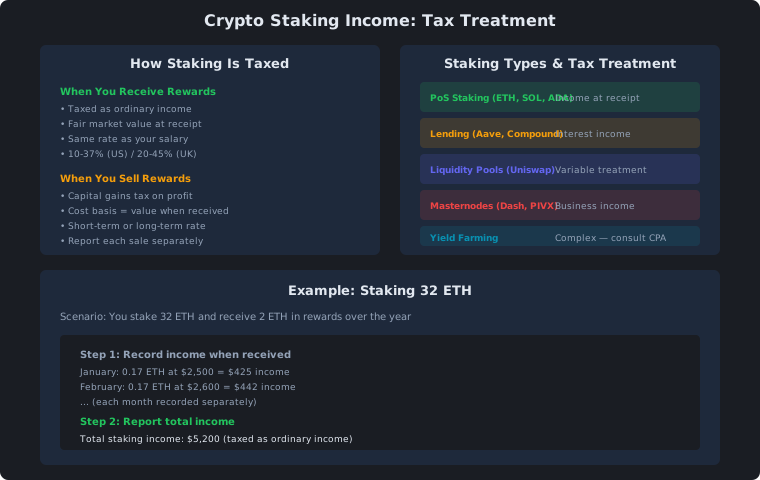
Staking Income Taxes: How Crypto Staking Is Taxed in 2026
June 16, 20263 min read
Key Takeaways
Staking rewards are taxed as ordinary income at fair market value when received, in the US (10-37%), UK (20-45%), and Canada (20-53%).
Selling staked crypto later triggers a second, capital-gains event on the difference between the sale price and the value when received.
Record the date and price of every reward — you need this cost basis to calculate the gain when you eventually sell.
In the US, exchanges issue 1099-MISC forms for staking rewards over $600, and income is reported on Schedule 1 rather than only when sold.
Tax software such as Koinly, CoinTracker, TaxBit, and ZenLedger auto-import staking rewards and aggregate hundreds of tiny income events into reportable totals.
Staking crypto earns rewards — and those rewards are taxable. The IRS, HMRC, and CRA all treat staking income as taxable income.
Here’s how to properly report your staking rewards.
How Staking Is Taxed
Step 1: Income When Received
Every time you receive staking rewards, it’s taxed as ordinary income at fair market value.
Country
Tax Rate
When Taxed
US
10-37%
When received
UK
20-45%
When received
Canada
20-53%
When received
Step 2: Capital Gains When Sold
When you sell the staked crypto, you pay capital gains tax on the difference between sale price and value when received.
Example
Amount
Received 1 ETH staking reward at $2,500
$2,500 income
Sold ETH later at $3,000
$500 capital gain
Total tax
Income tax on $2,500 + capital gains on $500
Staking Types and Tax Treatment
Staking Type
Tax Treatment
Examples
Proof-of-Stake
Income at receipt
ETH, SOL, ADA
Delegation
Income at receipt
DOT, ATOM, XTZ
Lending
Interest income
Aave, Compound
Liquidity Pools
Variable
Uniswap, Curve
Masternodes
Business income
Dash, PIVX
Yield Farming
Complex
Various DeFi
Real-World Example: Staking 32 ETH
Let’s say you stake 32 ETH and receive 2 ETH in rewards over the year:
Month
Rewards (ETH)
ETH Price
Income
Jan
0.17
$2,500
$425
Feb
0.17
$2,600
$442
Mar
0.17
$2,700
$459
Apr
0.17
$2,800
$476
May
0.17
$2,900
$493
Jun
0.17
$3,000
$510
Jul
0.17
$2,900
$493
Aug
0.17
$3,100
$527
Sep
0.16
$3,200
$512
Oct
0.16
$3,300
$528
Nov
0.16
$3,400
$544
Dec
0.16
$3,500
$560
Total
2.0
$5,969
US tax at 24% marginal rate: $1,432
Reporting Staking Taxes
US (IRS)
Form
Purpose
Form 1040
Report staking income as “Other Income”
Schedule 1
Line 8z for staking rewards
Form 8949
When you sell staked crypto
Schedule D
Capital gains summary
UK (HMRC)
Form
Purpose
Self Assessment
Report staking as income
SA100
Main tax return
SA108
Capital gains supplement
Trading records
Keep detailed logs
Canada (CRA)
Form
Purpose
T1 Return
Report staking income
Line 12100
Interest and other investment income
Schedule 3
Capital gains when selling
T5008
Securities transactions
Common Mistakes
Mistake
Consequence
Not reporting staking income
IRS penalties + back taxes
Reporting only when selling
Underreporting income
Not tracking reward dates
Can’t calculate cost basis
Ignoring small amounts
All income is taxable
Using wrong cost basis
Overpaying or underpaying taxes
How to Track Staking Taxes
Method
Best For
Tax software
Most users (auto-imports)
Exchange reports
Simple staking only
CSV export
Manual tracking
Tax professional
Complex DeFi staking
Recommended Tools
Tool
Staking Support
Price
Koinly
Excellent
$49-279
CoinTracker
Good
$59-599
TaxBit
Good
Free
ZenLedger
Good
$49-999
Quick reference
Key Point
Takeaway
Staking = income
Taxed when received, not when sold
Two tax events
Income tax + capital gains tax
Record everything
Date, amount, price for each reward
Report all amounts
Even small rewards are taxable
Use tax software
Auto-imports and calculates
Keeping staking records that work
The reason staking trips up so many filers is that the record-keeping demand is relentless — every reward, no matter how small, has a date and a value, and you will need all of them if you ever sell. The simplest system is a running ledger with the columns you will actually use: date, amount, coin, price, and local-currency value. Update it each time you receive a reward, and the same rows become both your income figure for the year and the cost basis for future sales. If that manual upkeep feels impractical across hundreds of rewards, let tax software do the lifting: tools such as Koinly, CoinTracker, TaxBit, and ZenLedger auto-import staking activity, assign a value on receipt, and aggregate the many tiny events into a single report line. Whichever route you choose, the goal is the same — a complete, date-stamped history you can hand to your return rather than reconstructing it under deadline pressure.
What most people get wrong
Two misunderstandings account for most staking tax problems. The first is reporting staking only when you sell, which understates income because the reward itself was taxable the moment it arrived. The second is failing to record the receipt value, leaving you unable to calculate the capital gain when you eventually dispose of the coins. Related traps include ignoring small rewards on the incorrect assumption that tiny amounts are exempt, and applying the wrong cost-basis method so that gains are over- or understated. Each of these is avoidable by treating every reward as a real income event at its market value on arrival and keeping the paper trail to prove it. On the enforcement side, do not assume your activity is invisible: exchanges issue 1099-MISC forms for staking rewards over $600, and the IRS matches those to your return, so an omission there is easily caught.
Common questions
Q: Is staking taxed differently from lending or liquidity pooling?
A: The core principle is shared — rewards are income when received at fair market value — but the classification can differ. Straightforward staking and delegation are income at receipt, lending produces interest income, and liquidity-pool and yield-farming rewards can be more complex, sometimes combining income with trading treatment.
Q: Should I use tax software or a spreadsheet?
A: For a few rewards, a spreadsheet with date, amount, coin, price, and value is perfectly adequate. For hundreds of auto-rewards, tax software is far more reliable because it values each event, aggregates them, and can carry the cost basis forward. Complex DeFi staking is best handled with a tax professional.
Frequently Asked Questions
When is staking income taxed?
When you receive it, at its fair market value, not when you eventually sell. This is the first of two events; the second is a capital gain or loss on any price change between receipt and sale.
How do I report staking rewards in the UK?
Report them as income on your Self Assessment return (SA100), with staking recorded as miscellaneous income. When you sell, report the resulting gains on the SA108 capital gains supplement and keep detailed trading logs.
Do I owe tax on tiny staking rewards?
Yes — all staking rewards are taxable income, even fractional amounts. Because there can be hundreds of small rewards, use a tax tool that aggregates them into a single line item rather than reporting each by hand.
What happens if I do not report staking income?
You risk penalties and back taxes, and you may also be underreporting income. The IRS in particular can match staking to your return via 1099-MISC forms that exchanges issue for rewards over $600, so failing to report is easy to detect.
PP
PaisayehPaisa Editorial Team
Financial education in plain language. Our team reviews every article for accuracy and clarity.