Crypto Tax-Loss Harvesting: How to Reduce Your Tax Bill
June 16, 20263 min read
Key Takeaways
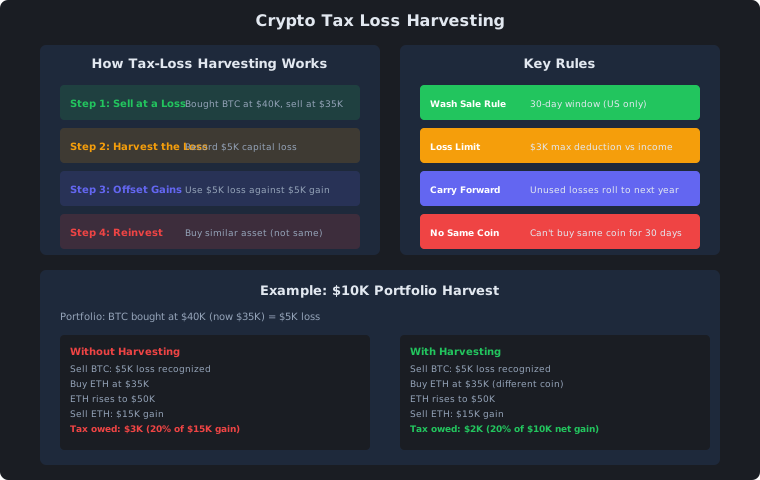
Tax-loss harvesting means selling losing positions to realise a loss, which offsets your gains and lowers your tax bill.
The US wash sale rule, UK same-day/30-day rule, and Canadian superficial loss rule all restrict buying the same asset back within roughly 30 days.
You can only harvest losses you actually dispose of — unrealised, lost-key, and most stolen or gifted positions don't count.
Timing matters: year-end reviews and sharp market drawdowns are the moments when harvesting delivers the most benefit.
Tax-loss harvesting is one of the most powerful crypto tax strategies. By selling at a loss, you can offset gains and reduce your tax bill.
Here’s how it works, the rules, and real examples.
How Tax-Loss Harvesting Works
Step 1: Identify Losses
Find crypto positions that are below your purchase price:
Asset
Bought At
Current Price
Loss
BTC
$40,000
$35,000
-$5,000
ETH
$3,000
$2,200
-$800
SOL
$100
$70
-$300
Step 2: Sell to Harvest
Sell the losing positions to realize the losses:
Sale
Loss Realized
Sell BTC
$5,000 loss
Sell ETH
$800 loss
Sell SOL
$300 loss
Total
$6,100 losses
Step 3: Offset Gains
Use the losses to offset your gains:
Gains
Losses
Net Taxable
$10,000 (sold NFT)
$6,100 (harvested)
$3,900
Step 4: Reinvest
Buy back into crypto (but not the same coin within 30 days):
Instead Of
Buy This
BTC
GBTC or MSTR stock
ETH
stETH or rETH
SOL
mSOL or jitoSOL
The Rules
US: Wash Sale Rule
Rule
Details
What
Can’t buy same “substantially identical” security within 30 days
When
Applies to crypto (IRS proposed rules)
Penalty
Loss disallowed
Workaround
Buy different crypto or ETF
UK: Same-Day Rule
Rule
Details
Same-day rule
Can’t offset if you buy same crypto same day
30-day rule
Can’t offset if you buy within 30 days
Bed and breakfasting
Old rule, still applies
Workaround
Buy different crypto or wait 30 days
Canada: Superficial Loss Rule
Rule
Details
What
Can’t claim loss if you buy same property within 30 days
Window
30 days before and after sale
Penalty
Loss added to cost basis of new shares
Workaround
Buy different crypto or wait
Tax-Loss Harvesting Example
Before Harvesting
Event
Amount
Sold ETH for $15,000 profit
+$15,000
Sold NFT for $5,000 profit
+$5,000
Total gains
$20,000
Tax at 20%
$4,000
After Harvesting
Event
Amount
Sold ETH for $15,000 profit
+$15,000
Sold NFT for $5,000 profit
+$5,000
Sold losing BTC
-$8,000
Sold losing SOL
-$2,000
Net gains
$10,000
Tax at 20%
$2,000
Savings: $2,000
When to Harvest
Market Condition
Strategy
Market down 20%+
Harvest all losses
Year-end (Nov-Dec)
Review for harvesting
After big gains
Offset with losses
Any time losses exist
Consider harvesting
What You Can Harvest
Asset
Taxable Event
Loss Amount
Crypto sold at loss
Yes
Full loss
NFT sold at loss
Yes
Full loss
DeFi position closed
Yes
Full loss
Staking rewards sold
Yes
Gain/loss on rewards
What You Can’t Harvest
Situation
Why
Unrealized losses
Must sell to harvest
Lost keys
No taxable event
Stolen crypto
Theft loss (limited deduction)
Gifted crypto
No disposal
Scenario by scenario
Key Point
Takeaway
What
Sell at loss to offset gains
US rule
30-day wash sale rule (proposed)
UK rule
30-day bed and breakfasting rule
Canada rule
Superficial loss rule
Best time
Market down 20%+ or year-end
Savings
Can save 20-37% on harvested losses
Putting a harvesting plan together
You do not need complexity to make harvesting work. Mid-year, review your portfolio for positions sitting well below cost and decide which you are genuinely happy to exit. As the year closes, revisit that list alongside your realised gains for the year so the losses land exactly where they reduce tax. For each candidate, confirm the relevant jurisdiction’s window — roughly 30 days on either side in the US, UK, and Canada — before repurchasing. If you want to stay in the asset, choose a close-but-not-substantially-identical alternative for the waiting period. A calendar reminder for November catches most people who otherwise forget.
What to avoid
The recurring mistake in tax-loss harvesting is chasing the deduction rather than the position. Selling a coin you still believe in purely to bank a loss means paying the price of a potential rebound, and the rules punish a quick rebuy by disallowing the loss entirely. Many investors also overlook the traps: unrealised losses can’t be harvested until there is a disposal, worthless positions with lost keys generate no taxable event, and stolen or gifted crypto provide little or no relief. Finally, don’t let harvesting turn into market timing — the goal is to trim what you no longer want and offset real gains, not to optimise a deduction into an active-management hobby.
Common questions
Most people wonder whether harvesting is worth the effort for small positions. If your losses are tiny and your gains smaller, the paperwork may outweigh the benefit, and the tax software you already use will tell you the numbers either way. A more pressing question is how these rules interact when you hold crypto across several countries or platforms — each jurisdiction applies its own window, so treat your holdings per country of residence. And because the IRS wash sale rule has been proposed but not finalised, the safe approach is to wait the 30 days regardless rather than assume crypto is exempt. When losses are large, a tax professional can confirm how they interact with your wider capital gains picture.
Frequently Asked Questions
How does tax-loss harvesting actually save me money?
By selling a position at a loss, you realise that loss and use it to offset your taxable gains, reducing net taxable gains. In the worked example, $6,100 of harvested losses cut a $10,000 gain down to $3,900 and lowered the tax from $4,000 to $2,000.
Can I buy the same crypto back right after selling?
Not without risking the loss being disallowed. The US wash sale rule, the UK 30-day rule, and the Canadian superficial loss rule all prevent claiming a loss if you buy the same or substantially identical asset back within roughly 30 days. Buy a different coin or wait out the window instead.
Do I have to sell everything to harvest losses?
No, only positions you actually dispose of. If you still believe a crypto will recover, selling purely for tax reasons means you might miss the rebound. Harvest when you want to exit or when the offset genuinely benefits your tax position.
When is the best time to harvest losses?
Historically the best windows are sharp market declines of 20% or more and the November-to-year-end period, when you know your gains for the year and can offset them precisely. Reviewing before the tax year closes is the most common way investors capture this benefit.
PP
PaisayehPaisa Editorial Team
Financial education in plain language. Our team reviews every article for accuracy and clarity.