DeFi Taxes: Complete Guide to Taxing DeFi Activities in 2026
June 16, 20263 min read
Key Takeaways
Every token swap is a taxable disposal — swapping ETH for USDC, or swapping pegged tokens, still crystallises a capital gain or loss.
Yield farming and airdrop rewards are income at fair market value when received, and compounding rewards is taxed each time.
Adding liquidity usually isn't a disposal, but withdrawing from a pool is, and trading fees are income at receipt.
Borrowing against crypto isn't taxable, but a liquidation is treated as a sale of the collateral.
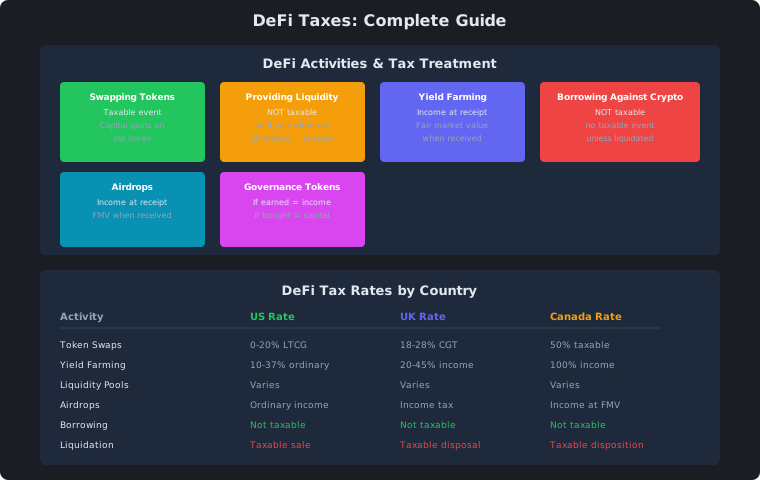
DeFi creates complex tax situations. Swapping tokens, providing liquidity, yield farming, and borrowing all have different tax treatments.
Here’s the complete breakdown of DeFi taxes.
DeFi Activities and Tax Treatment
Token Swaps (Uniswap, SushiSwap)
Event
Taxable?
Treatment
Swap ETH for USDC
Yes
Capital gains on ETH
Swap USDC for ETH
Yes
Capital gains on USDC
Swap same pegged tokens
Yes
Still taxable
Each swap = a sale
Always
Treat as disposing of old token
Example: Swap 1 ETH ($2,500) for 2,500 USDC
You disposed of ETH at $2,500
If your ETH cost basis was $1,500, you have $1,000 capital gain
Taxed at your capital gains rate
Providing Liquidity (LP Tokens)
Event
Taxable?
Treatment
Add liquidity (deposit tokens)
Usually no
No disposal
Receive LP tokens
No
Not income
Remove liquidity (withdraw)
Yes
Capital gains on tokens
Earn trading fees
Yes
Income at receipt
Impermanent loss
Not until realized
Only when withdrawing
Yield Farming
Event
Taxable?
Treatment
Stake LP tokens
No
No disposal
Receive farm tokens
Yes
Income at FMV
Sell farm tokens
Yes
Capital gains
Compound rewards
Yes
Income each time
Airdrops
Event
Taxable?
Treatment
Receive airdrop
Yes
Income at FMV
Sell airdrop
Yes
Capital gains
Unclaimed airdrop
No
Not until claimed
Borrowing Against Crypto
Event
Taxable?
Treatment
Borrow against collateral
No
Not a taxable event
Pay interest
No
Not deductible (personal)
Liquidated
Yes
Treated as sale of collateral
Repay loan
No
No tax event
Country-Specific Rules
Activity
US
UK
Canada
Token Swaps
0-20% LTCG
18-28% CGT
50% taxable
Yield Farming
10-37% income
20-45% income
100% income
Liquidity Pools
Varies
Varies
Varies
Airdrops
Ordinary income
Income tax
Income at FMV
Borrowing
Not taxable
Not taxable
Not taxable
Liquidation
Taxable sale
Taxable disposal
Taxable disposition
Record-Keeping for DeFi
You need to track:
Data Point
Why
Date/time
To determine short vs long-term
Transaction type
Swap, LP, farm, borrow
Tokens involved
Both sides of the transaction
Amounts
Token amounts and USD value
Gas fees
For cost basis calculation
Wallet addresses
For audit trail
DeFi Tax Software
Not all tax software handles DeFi well. Here’s what works:
Software
DeFi Support
Chains
Price
Koinly
Excellent
300+
$49-279
CoinTracker
Good
100+
$59-599
TokenTax
Good
Major chains
$65-799
ZenLedger
Good
20+
$49-999
Accointing
Good
100+
$49-299
Common DeFi Tax Mistakes
Mistake
Why It’s Wrong
Ignoring token swaps
Every swap is taxable
Not tracking LP positions
Withdrawals are taxable
Forgetting airdrops
Income when received
No records of gas fees
Needed for cost basis
Treating DeFi as tax-free
All crypto is taxable
Activity by activity
Key Point
Takeaway
Swaps
Always taxable (capital gains)
Liquidity pools
Taxable when withdrawing
Yield farming
Income at receipt
Airdrops
Income at FMV
Borrowing
Not taxable (until liquidated)
Track everything
Use DeFi-compatible tax software
Building a DeFi record-keeping routine
DeFi moves fast and produces dozens of small events, so the only reliable defence is a record routine that runs while you transact rather than after. For each interaction capture the date and time (to determine short versus long-term holding), the transaction type, the tokens on both sides, the amounts with their USD value, the gas fees for cost basis, and the wallet addresses for an audit trail. Services such as Koinly support 300+ protocols and auto-import from MetaMask, Trust Wallet, and Ledger, which removes much of the manual burden. When you later file, the software maps each swap, reward, and withdrawal to the correct tax treatment instead of leaving you to reconstruct months of activity from memory.
What to avoid
The mistakes that most often catch out DeFi users are about classification rather than arithmetic. Counting a token swap as a mere position change when it is really a disposal understates gains. Treating a liquidity-pool withdrawal as a non-event when it is taxable, or forgetting that airdrop and farming rewards are income the moment they arrive, leads to underreported income. Rebasing tokens and multi-hop swaps confuse even experienced trackers, and flash loans sit in a grey area that most software handles poorly. The practical answer is to assume every crypto interaction is taxable until you have confirmed otherwise, and to lean on a tax professional when your activity involves the genuinely complex corners of DeFi.
Frequently Asked Questions
Is swapping one token for another taxed in DeFi?
Yes. Every token swap is a taxable disposal. For example, swapping 1 ETH at $2,500 that you bought for $1,500 creates a $1,000 capital gain. Even swapping pegged tokens is still a taxable event.
How are liquidity pool deposits taxed?
Depositing tokens to add liquidity is usually not a disposal and receiving LP tokens is not income. But removing liquidity is taxable on the tokens withdrawn, and any trading fees you earn are income at receipt.
Are yield farming rewards taxable?
Yes. Farm tokens you receive are income at their fair market value when received, selling them creates a capital gain, and compounding rewards is a taxable event each time the reward is received.
Is borrowing against my crypto taxable?
Borrowing against collateral is not a taxable event, and personal interest isn't deductible. However, if your position is liquidated, the liquidation is treated as a sale of the collateral and is taxable.
PP
PaisayehPaisa Editorial Team
Financial education in plain language. Our team reviews every article for accuracy and clarity.