Crypto moves in cycles: bull markets (prices rising) and bear markets (prices falling). Understanding these cycles is the key to building wealth in crypto.
Here’s how to spot them and what to do.
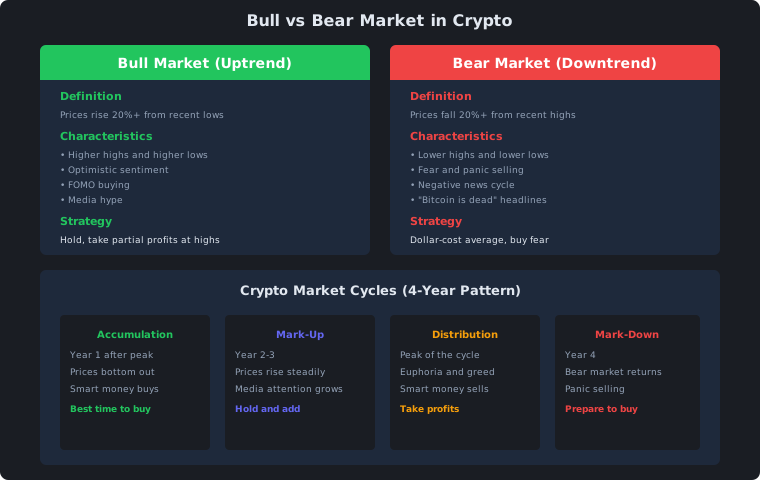
Bull Market (Uptrend)
Definition
Prices rise 20%+ from recent lows and continue climbing.
Characteristics
- Higher highs and higher lows
- Optimistic sentiment
- FOMO buying
- Media hype
- “Everyone is making money”
What to Do
| Strategy | Action |
|---|---|
| Hold | Don’t sell too early |
| Take profits | Sell 10-20% at each new high |
| Don’t FOMO | Don’t buy at the top |
| Set targets | Know when to exit |
Bear Market (Downtrend)
Definition
Prices fall 20%+ from recent highs and continue declining.
Characteristics
- Lower highs and lower lows
- Fear and panic selling
- Negative news cycle
- “Bitcoin is dead” headlines
- Everyone says “it’s over”
What to Do
| Strategy | Action |
|---|---|
| Don’t panic sell | Selling at the bottom is the worst mistake |
| Dollar-cost average | Buy regularly at lower prices |
| Rebalance | Buy more at discounts |
| Stay calm | Every bear market has recovered |
The 4-Year Crypto Cycle
Crypto follows a roughly 4-year pattern tied to Bitcoin halving events:
| Phase | Year | What Happens | Strategy |
|---|---|---|---|
| Accumulation | Year 1 | Prices bottom, smart money buys | Buy aggressively |
| Mark-Up | Year 2-3 | Prices rise, attention grows | Hold and add |
| Distribution | Peak | Euphoria, smart money sells | Take profits |
| Mark-Down | Year 4 | Bear market, panic selling | Prepare to buy |
Historical Cycles
| Cycle | Peak | Bottom | Recovery |
|---|---|---|---|
| 2013-2017 | $1,100 | $200 | 5.5x |
| 2017-2021 | $20,000 | $3,200 | 6.25x |
| 2021-2025 | $69,000 | $15,500 | 4.5x |
How to Spot Market Tops
| Signal | What It Means |
|---|---|
| Euphoria everywhere | Taxi drivers talking about crypto |
| New all-time highs daily | FOMO is extreme |
| Leverage at record highs | Too much borrowing |
| Meme coins pumping | Speculation is rampant |
| ”This time is different” | It never is |
How to Spot Market Bottoms
| Signal | What It Means |
|---|---|
| ”Bitcoin is dead” headlines | Maximum fear |
| 90%+ decline from highs | Capitulation complete |
| Miners shutting down | Weak hands out |
| Low volume | No buyers left |
| Everyone says “never again” | Best time to buy |
The Strategy: Buy Fear, Sell Greed
| Market Phase | Sentiment | Action |
|---|---|---|
| Extreme fear | ”It’s going to zero” | Buy aggressively |
| Fear | ”I’m worried” | Dollar-cost average |
| Neutral | ”Let’s wait and see” | Hold positions |
| Greed | ”I’m making money” | Start taking profits |
| Extreme greed | ”It’ll never stop” | Sell most positions |
The cycle at a glance
| Key Point | Takeaway |
|---|---|
| Bull market | Prices rise 20%+, hold and take profits |
| Bear market | Prices fall 20%+, buy and don’t panic |
| 4-year cycle | Follows Bitcoin halving |
| Buy fear | Best returns come from buying bottoms |
| Sell greed | Best protection comes from selling tops |
| Every cycle | Bear markets always recover |
The errors that repeat each cycle
Every cycle, the same mistakes claim the same money. Panic selling near the bottom is the most costly because it converts a paper loss into a permanent one and removes you from the eventual recovery. On the other side, buying at the peak — usually in a wave of euphoria, leverage, and meme-coin mania — finances the very people who bought early and are now selling into your FOMO.
Leverage compounds both errors. A position opened on margin that was fine during the climb becomes a forced sell exactly at the bottom, because a liquidation event removes your judgment from the equation. Finally, neglecting to take any profits in the distribution phase means the entire cycle’s gains evaporate in the drawdown. The antidote is boring: define your buying and selling levels in advance, keep leverage low or absent, and stay within a position size you can hold without panic.
Positioning for the next uptrend
The work that matters is done while the market is quiet. Start by deciding what fraction of your portfolio belongs in crypto and stick to that allocation through both fear and greed. Next, keep a small reserve of cash or stablecoins specifically to deploy during capitulation, when fear is at its worst — that is historically where the cycle’s best returns were bought. Prepare a target price list for taking profits on the way up, and rebalance quietly rather than reacting to headlines. By the time the next bull market arrives, the patient investor who survived the bear is the one positioned to benefit from it.