Market cap is the most important number in crypto. It tells you the true size and value of a cryptocurrency — not just its price.
Here’s how it works and why it matters.
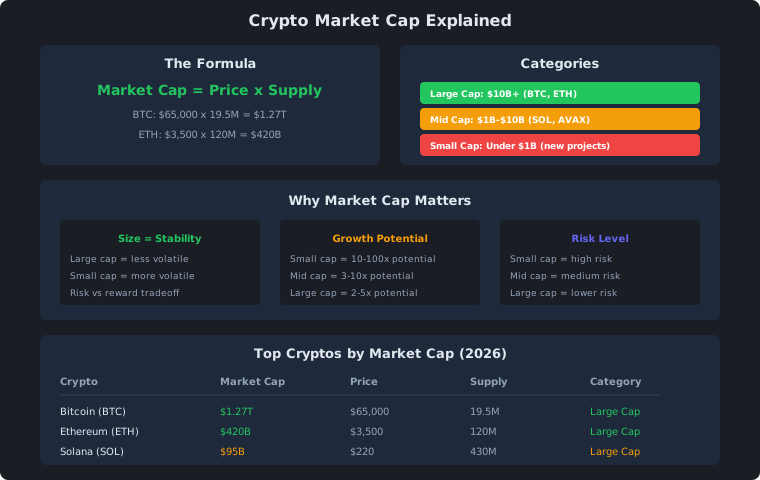
The Formula
Market Cap = Price x Circulating Supply
| Crypto | Price | Supply | Market Cap |
|---|---|---|---|
| Bitcoin | $65,000 | 19.5M | $1.27 trillion |
| Ethereum | $3,500 | 120M | $420 billion |
| Solana | $220 | 430M | $95 billion |
| Dogecoin | $0.15 | 143B | $21.5 billion |
Why Market Cap Matters
1. Size = Stability
| Category | Market Cap | Volatility | Risk |
|---|---|---|---|
| Large Cap | $10B+ | Lower | Lower |
| Mid Cap | $1B-$10B | Medium | Medium |
| Small Cap | Under $1B | High | High |
2. Growth Potential
| Category | Potential | Example |
|---|---|---|
| Large Cap | 2-5x | BTC, ETH |
| Mid Cap | 3-10x | SOL, AVAX |
| Small Cap | 10-100x | New projects |
3. Risk Assessment
| Category | Downside Risk | Example Crash |
|---|---|---|
| Large Cap | -50 to -80% | BTC 2022 |
| Mid Cap | -70 to -90% | SOL 2022 |
| Small Cap | -90 to -100% | Many go to zero |
Top Cryptos by Market Cap (2026)
| Rank | Crypto | Market Cap | Category |
|---|---|---|---|
| 1 | Bitcoin (BTC) | $1.27T | Large Cap |
| 2 | Ethereum (ETH) | $420B | Large Cap |
| 3 | Tether (USDT) | $120B | Large Cap |
| 4 | Solana (SOL) | $95B | Large Cap |
| 5 | BNB (BNB) | $85B | Large Cap |
| 6 | XRP (XRP) | $45B | Large Cap |
| 7 | Cardano (ADA) | $18B | Large Cap |
| 8 | Avalanche (AVAX) | $15B | Large Cap |
| 9 | Dogecoin (DOGE) | $21.5B | Large Cap |
| 10 | Polkadot (DOT) | $10B | Large Cap |
How to Use Market Cap
Investment Decisions
| Goal | Market Cap Strategy |
|---|---|
| Safety | Stick to large cap (BTC, ETH) |
| Growth | Mix large + mid cap |
| Speculation | Small portion in small cap |
| Diversification | Spread across all three |
Comparing Cryptos
| Comparison | Price | Market Cap |
|---|---|---|
| BTC vs ETH | BTC higher | BTC 3x larger |
| SOL vs ADA | SOL higher | SOL 5x larger |
| DOGE vs SHIB | DOGE higher | DOGE 10x larger |
Putting market cap to use
The formula is simple: Price x Supply = Market Cap. Large-cap coins above $10B tend to be more stable with lower downside risk, while mid-cap coins between $1B and $10B offer more growth potential. Small-cap coins under $1B can deliver outsized returns but frequently go to zero. Use these categories to match your portfolio to your risk tolerance, and always compare market caps rather than raw prices when evaluating whether a coin is expensive or cheap.
Common errors investors make with market cap
The most frequent mistake is comparing coins by price rather than market cap. A coin at $0.01 is not a bargain compared to a coin at $100 — supply determines the real value. Ignoring supply changes is another pitfall: inflationary tokens increase supply over time, which dilutes your holdings even if the price stays flat.
Over-concentrating in small-cap coins because they look “cheap” exposes you to catastrophic losses. Many small-cap projects go to zero entirely, and even the ones that survive can take years to recover. Failing to understand market cap categories means you cannot accurately assess whether an investment fits your risk profile. Large-cap coins are steadier but limited in upside; small-cap coins are the opposite.
Finally, do not assume market cap alone tells you whether a project is good. A high market cap can reflect hype rather than substance, and a low market cap can mean the project is genuinely undervalued. Market cap is a starting point for research, not a conclusion.
Key questions about market cap answered
Q: How does market cap relate to risk? A: Market cap is one of the most reliable risk indicators in crypto. Large-cap coins (over $10B) have survived multiple market cycles and are less likely to go to zero. Mid-cap coins ($1B-$10B) carry more risk but offer more growth potential. Small-cap coins (under $1B) are the riskiest — many fail entirely, but the survivors can deliver the highest returns.
Q: Can a coin’s market cap exceed $1 trillion? A: Bitcoin has already exceeded $1 trillion in market cap, and Ethereum has approached it. Whether other cryptocurrencies reach that level depends on adoption, utility, and market conditions. Market cap has no theoretical ceiling — it grows as price and supply increase.
Q: What is the difference between market cap and fully diluted valuation? A: Market cap uses the current circulating supply. Fully diluted valuation (FDV) uses the total supply that will ever exist, including tokens not yet unlocked. If a project has 1 billion tokens but only 200 million in circulation, the FDV is 5x the market cap — meaning future supply increases could significantly dilute your holdings.