Stocks or property: the two most famous ways to build wealth, and the two most common retirement fantasies. Readers of every age ask which makes more money, and the honest answer is more subtle than either camp would like. Historically their average returns are close, but the journey could not be more different — entry costs, effort, liquidity, leverage and tax all pull in opposite directions. This guide walks through each difference in plain language, so you can decide based on your money, your time and your temperament rather than on who shouts loudest.
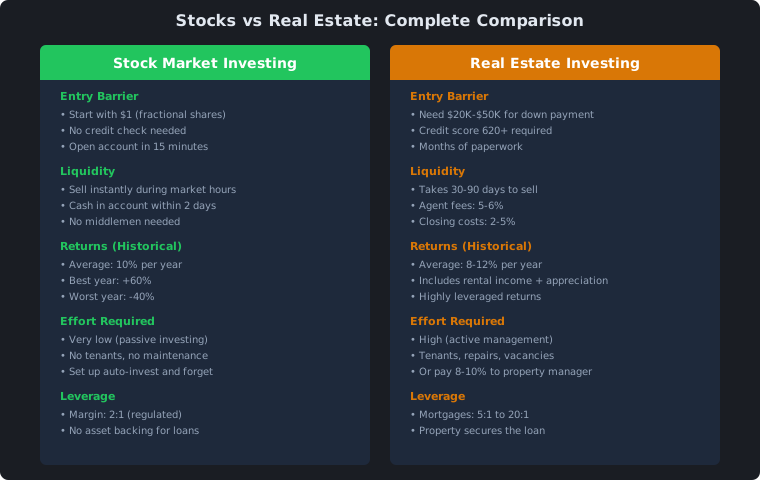
Stocks and property at a glance
| Factor | Stocks | Real Estate |
|---|---|---|
| Minimum to start | $1 | $20,000-$50,000 |
| Liquidity | Instant (2 days) | 30-90 days |
| Average return | 10%/year | 8-12%/year |
| Effort level | Passive | Active |
| Leverage | 2:1 | 5:1 to 20:1 |
| Tax advantages | Moderate | Significant |
| Income | Dividends | Rent |
Note that these headline figures are largely American in origin and set in dollars, but the shape of the comparison holds for UK investors: stocks still cost almost nothing to start, sell in two days and demand nearly no effort, while property still needs a hefty deposit, months to sell and real management. The table is a fair summary of the trade-off. Everything else on this page is really just unpacking those seven rows.
What the returns actually look like
On raw returns alone, stocks have the edge on average — but not by enough to end the argument. US stocks have averaged 12.8% over the last ten years, 10.2% over thirty, 11.0% over fifty, and roughly 10.4% all-time for the S&P 500. Real estate has averaged 8.5% over the last decade on a national basis, around 9.2% over thirty years, with the best markets — think Austin and Phoenix in their boom phases — running at 15-20% and rental income adding perhaps 3-5% more on top of appreciation. In other words: stocks slightly outperform on average, which is exactly why property investors lean so heavily on leverage to make up the gap.
Leverage: property’s superpower and its trap
Leverage — borrowing to buy — is where real estate can genuinely outrun stocks, and it is the single most important concept to understand before you ever view a house. Picture a £/$50,000 deposit on a £/$250,000 property, a 5:1 ratio typical of buy-to-let. If the property appreciates 5%, that is a £/$12,500 gain — 25% on the money you actually put in. Add £/$6,000 a year of net rental income and your first-year return sits around 37%. Your stock portfolio would need to produce 37% in a year to match that, which happens perhaps once a decade. That is the magic, and it is real.
The mirror image is just as real. The same 5:1 to 20:1 multiplier works on the way down. A 10% price fall at 10:1 leverage wipes out your entire deposit; a vacancy, a nightmare tenant or an interest-rate rise while the mortgage rate floats can push a heavily borrowed landlord into negative equity and forced sale. Stocks can lose 30-50% in a severe crash and you are still holding a diversified asset. Property concentrates everything in one building on one street, and the hardest moment to sell a house is always the moment you have to.
Your time is the hidden cost
Nobody advertises the hours. Stocks demand almost nothing: around 15 minutes to open an account, two minutes to buy an index fund, maybe thirty minutes a year to rebalance — call it an hour annually. Property is a different world: finding the property runs to 20-40 hours, due diligence takes 10-20 more, and the closing process swallows another 20-30. Then the ongoing load: 2-4 hours a week of property management and 5-10 hours a month of maintenance, which commonly lands at 200-400 hours a year. If you value your own time, that is the equivalent of £/$10,000-20,000 a year of hidden cost. For someone in the prime earning years of their career, that figure alone often settles the argument — which is why the investors who favour property tend to be able to outsource the work.
Taxes, briefly and honestly
Tax is where property’s reputation for cleverness mostly comes from, and where the US tax system can flatter it. On the property side in the United States, mortgage interest and repairs are deductible, property taxes are deductible up to $10,000, and a £/$250,000 rental depreciates over 27.5 years — roughly a $9,090 a year deduction that can shelter a meaningful chunk of rental income while the asset itself appreciates. US real estate also gets a 1031 exchange, which defers capital gains tax when you trade one property for another. On the stock side, long-term capital gains are taxed at 0-20% against ordinary income rates of 22-37%, tax-loss harvesting lets you offset gains with losses, and tax-advantaged accounts (Roth IRAs and 401(k)s) shelter growth.
UK readers should read that list with a pinch of salt, because the British rules are different: the 1031-style rollover has no direct UK equivalent, but ISAs and SIPPs shelter shares far more cleanly than most property can ever be sheltered. The general shape survives the translation, though: property offers more individual tax tricks, while stocks offer the cleaner long-term wrapper. The right habit in either country is the same — understand the tax treatment before you commit, because it quietly changes the real return.
Risk, compared honestly
The market-risk numbers are well known and should be repeated plainly. In a severe downturn, stocks can lose 30-50%, and property typically loses 20-30% — but price falls are only half the story. Stocks carry no tenant risk, no vacancy risk, no maintenance surprises, and when you need cash you can sell within two days. Property has tenants who can default, voids between lets, repairs that arrive in threes, and a sale that takes 30-90 days even in a good market. True, a diversified tracker spreads one concentrated bet across hundreds of companies, and its leverage is essentially your broker’s margin at around 2:1 — but that is small relative to the 5:1 to 20:1 a landlord carries. Risk does not decide this contest; it just defines which kind of risk you prefer.
REITs: property without the tenants
If the appeal of property is the returns and the drawbacks are the work, the natural compromise is a REIT — a Real Estate Investment Trust that owns and operates income-producing buildings and trades on the stock market. You buy a REIT like a share, you get rental income in the form of dividends, and you can sell in two days. On major international platforms the familiar names include VNQ, a diversified US REIT yielding around 3.8%; O, which pays monthly and yields roughly 4.5%; and VNQI, an international REIT on about 4.2%. Yields vary with the market, so treat those as typical levels rather than guarantees. You gain real estate exposure with stock-like liquidity, no tenants and no void periods — at the cost of giving up leverage and the hands-on control of direct ownership.
The ten-year check
The marketing-free way to weigh it all is a simple ten-year projection. Take £/$100,000 and see where two strategies land in a decade:
| Scenario | Starting | Year 10 | Total Return |
|---|---|---|---|
| S&P 500 ETF | $100,000 | $259,374 | +159% |
| Rental property (5:1 leverage) | $100,000 | $320,000 | +220% |
| Rental property (after expenses) | $100,000 | $260,000 | +160% |
| REIT ETF | $100,000 | $235,000 | +135% |
The takeaway is worth reading twice. Leveraged property looks magnificent on paper — 220% — but only if you manage it impeccably. The moment you subtract the real costs of ownership, the property number falls to £/$260,000, landing almost exactly on top of the plain S&P 500 ETF. That is the entire debate in one table: leverage is the difference, and managing well is the price of the ticket.
The real estate trap
And managing well is genuinely hard, because the costs are far higher than beginners expect. A realistic landlord should plan for roughly 8% to vacancies, 5% to repairs, 10% to management, 1% to insurance and 2% to taxes — about 26% of gross rental income gone before a single penny reaches the owner. New landlords discover this only after their first roof leak and their first empty quarter. Debt-free and patient, with a decent yield and a long horizon, property is a fine asset — but the people who make money from it treat those 26 points as the baseline, not as bad luck.
Bottom line
Nothing about the stocks-versus-property question has a once-and-for-all answer, because the two assets reward you in different currencies: stocks pay in ease, liquidity and steady average returns; property pays in leverage, cash flow and tax angles, at a heavy cost in money, time and stress. The figures come down to this — after expenses, the returns on a well-run property and a plain stock index are comparable, and leverage alone is what separates the winners. The best investors typically do both: begin with stocks, which are cheap, passive and easy, build capital and confidence, and add property or REITs only when they have the deposit, the time and the appetite for the work. Diversify across asset classes, and let your age, your hours and your stomach settle the split.