Two decades of discussion have turned “ETF versus mutual fund” into the personal-finance equivalent of a pub debate. Friends argue about it, headlines promise a definitive winner, and yet the honest conclusion is quieter than either side would like: both are perfectly good ways to own a diversified portfolio, and for most people the choice will be settled by modest differences in cost, tax treatment, and convenience rather than by one vehicle being fundamentally superior.
Understanding those differences does matter, though. Get the vehicles right and you keep more of your returns; muddle through and you can pay for the privilege with higher fees and avoidable taxes. This guide works through the real differences in plain English, so you can choose with confidence.
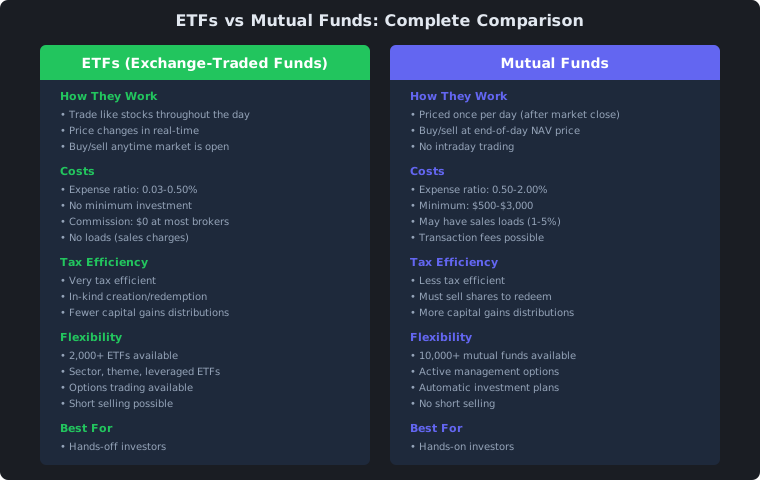
The core difference: how they trade
The mechanical difference shapes everything else. An exchange-traded fund is a fund whose units trade on a stock exchange throughout the day, exactly like a share. You buy and sell at whatever price the market currently demands, and you can place limit orders, stop orders, and time your purchases during trading hours. A mutual fund, by contrast, is priced once per day after the market closes, and all buy and sell orders are executed at that single end-of-day price, known as the net asset value. Your order confirms at a price you only discover later.
This matters in two ways. For long-term investors, the intraday flexibility of an ETF is a convenience rather than a decisive edge — a daily price is perfectly acceptable when you are buying once a month and holding for decades. Where it matters is transaction structure: an ETF purchase requires at least the price of one unit (or a fractional-share scheme), whereas a mutual fund often lets you contribute a set amount — £50 or $50 a month, say — and buy whatever fraction of a unit that buys. Minimum investments for mutual funds have historically ranged from around $500 to $3,000 on some platforms, which is where the small-regular-contribution advantage and the minimum-investment disadvantage of mutual funds both sit.
The cost comparison
Fees are where the two vehicles genuinely diverge. For plain index funds the gap is small: a typical US index ETF charges around 0.03% and the equivalent mutual fund around 0.04%; international index funds run closer to 0.07% versus 0.10%; bond indexes around 0.05% versus 0.06%. The gap widens substantially in the active arena, where mutual funds historically charge more — 0.75-2.00% against perhaps 0.50-1.00% for an active ETF.
The economics of that difference are worth making concrete. On a $100,000 portfolio, an index ETF at 0.03% costs you $30 a year; a middle-of-the-road active mutual fund at 0.50% costs $500. That is a $470 annual difference that compounds quietly over decades — and the mutual fund has to outperform by the same margin just to break even.
| Feature | ETF | Mutual Fund |
|---|---|---|
| U.S. index | 0.03% | 0.04% |
| International index | 0.07% | 0.10% |
| Bond index | 0.05% | 0.06% |
| Active management | 0.50-1.00% | 0.75-2.00% |
The second cost difference is the sales load, a historical relic that mostly survives in the mutual fund world. ETFs never carry front-end or back-end loads; some mutual funds still charge a front-end load of up to 5.75% (meaning $5,750 of every $100,000 vanishes at purchase), a back-end load of up to 1%, or a 12b-1 fee of 0.25-1.00% that covers marketing rather than investing. The fix is simple: always choose no-load funds, and treat any load-bearing fund as a warning sign. A 5% front-end load on $10,000 leaves only $9,500 invested — a $500 gap that, at 10% growth over ten years, costs you roughly $1,300 in foregone compounding.
Tax efficiency: the quiet differentiator
The most important difference for taxable accounts is tax efficiency. When investors sell shares of a mutual fund, the fund often has to sell underlying securities to raise the cash to pay them — and those sales trigger capital gains that are distributed to every remaining shareholder, including ones who never sold anything. ETFs largely sidestep this through an in-kind creation and redemption process, in which securities are exchanged directly with authorised participants rather than sold for cash. The result is that ETFs rarely make capital gains distributions, while mutual funds routinely make them annually.
The practical effect is a persistent tax drag. Annualised, the drag from capital gains distributions is commonly estimated at up to 0-0.5% a year for ETFs and 1.0-2.0% for mutual funds — a genuine, compounding disadvantage in a taxable account. In a retirement or tax-sheltered wrapper such as an ISA, SIPP, or 401(k), the gap matters far less, because capital gains inside those accounts are tax-free or tax-deferred anyway. For a UK investor using a Stocks & Shares ISA, this part of the debate largely dissolves.
| Factor | ETF | Mutual Fund |
|---|---|---|
| Capital gains distributions | Rare | Annual |
| In-kind creation/redemption | Yes | No |
| May sell securities to meet redemptions | No | Yes |
| Typical annual tax drag | 0-0.5% | 1.0-2.0% |
Performance: the same underlying assets
Because the two vehicles can hold identical portfolios, performance differences are mostly the fees and taxes described above rather than the manager’s skill. Published figures comparing ten-year S&P 500 returns often show ETFs at roughly 12.8% gross and mutual funds at 12.5% before costs, narrowing further once the same index and similar expense ratios are compared. After fees and taxes, an ETF typically retains a small but real advantage, while the honest caveat is that a skilful active mutual fund manager in a niche area such as small-cap value or emerging markets can outperform an index fund — before the higher fee, and inconsistently enough that most people come out worse.
The practical verdict is that for identical market exposure between comparable low-cost products, an ETF is usually slightly ahead on cost and tax. Mutual funds remain the right answer when automation and small regular contributions matter more, or when you want a genuinely skilled active manager you trust.
Choosing the right one for you
The deciding questions are simpler than the marketing suggests. If you are investing in a taxable account in a country with capital gains tax on realised gains, the ETF’s tax efficiency is a real edge — and in most cases the deciding factor. If you want to set up a small monthly contribution and let it drip-feed automatically, a mutual fund often wins because it is built for exact-amount contributions with no minimum share price. If you are investing inside a UK ISA or SIPP, tax-efficiency is largely moot, and the choice comes down to which vehicle your platform handles more cheaply.
| Situation | Better choice |
|---|---|
| Taxable account | ETF (tax efficiency) |
| Small regular amounts via automation | Mutual fund |
| Want intraday flexibility, limit orders | ETF |
| Passive index investing | Either — usually ETF at lower cost |
| Access to a specific active manager | Mutual fund |
The popular fund pairs give a sense of the practical landscape: on the US side, VTI (US total market ETF, 0.03%) versus VTSAX (mutual fund, 0.04%); VOO (S&P 500 ETF, 0.03%) versus VFIAX (mutual fund, 0.04%); VXUS (international ETF, 0.07%) versus VTIAX (mutual fund, 0.11%); BND (bond ETF, 0.03%) versus VBTLX (bond mutual fund, 0.05%); and VUG (growth ETF, 0.04%) versus VIGAX (growth mutual fund, 0.05%). The pattern is consistent: the ETF is a touch cheaper across the board.
The bottom line
For most investors, a low-cost index ETF held through a tax-efficient wrapper is the simpler, cheaper default — the vehicle loses on nothing important except automation convenience. If you want automatic monthly contributions in exact amounts, or you specifically want a fund built around regular saving rather than share-by-share dealing, a mutual fund is just as valid and ought not to cost much more if you choose a no-load, low-expense-ratio product. Either way, the groundwork is the same: know what you are paying in ongoing charges and dealing fees, favour funds that track broad markets, and let both the tax differences and the automation features guide you. Held in the right account, an ETF and a mutual fund invested in the same index will both do the essential job — grow your money for decades — so choose on cost and convenience, and stop worrying.