Passive income — money that lands without you trading hours for it — is the most advertised idea in personal finance and, handily, one of the easiest to reduce to honest arithmetic. The dream part is real: a portfolio that pays you while you sleep, and lets each reinvested dividend compound toward a larger one next year. The fantasy part is the promised route there, because anyone can sell you a “10% guaranteed” product that quietly refunds your own capital back to you as yield. This guide builds the boring alternative: a plain, diversified, four-stream portfolio whose entire job is to produce you a growing income stream, from the first hundred pounds to the first thousand pounds a month.
The figures below are illustrative, assume a mid-2020s rate environment, and tickers are US-listed examples with UK and global equivalents on any major platform. The portfolio itself is currency-agnostic.
The four income streams
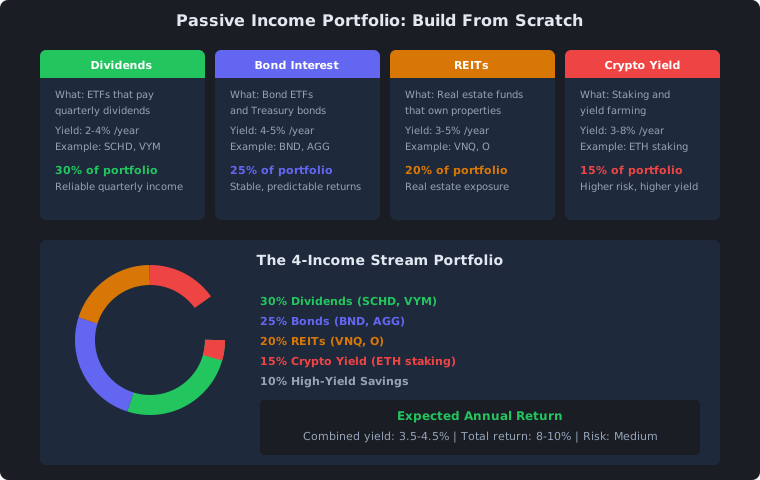
A resilient income portfolio does not rely on one instrument. It stacks several uncorrelated payers so that when one starves, the others feed you. In rough weights, this plan runs 30% dividend ETFs, 25% bond funds, 20% real estate, 15% crypto yield for those who want it — and 10% cash as a buffer and rebalancing tool.
Dividend ETFs (30% of the portfolio). These own baskets of established companies that pay regular dividends, giving you the profit-sharing without the single-stock risk. Typical yields run 2-4%. On US platforms, SCHD (around 3.2% yield, 0.06% fee), VYM (around 2.8%, 0.06%) and JEPI (around 7.2%, 0.35%) cover the range from steady blue-chip dividends to higher-yielding, monthly-paying strategies. The appeal is durability: companies like Johnson & Johnson, Coca-Cola and Procter & Gamble have paid dividends for fifty years or more, through wars, crashes and pandemics. Income that skips every tech-hype cycle is income you can plan a life around.
Bond funds (25%). Bonds pay you for lending — to governments or companies — and they do it regardless of whether the stock market is having a good year. Fund yields here run around 4-5%: BND (around 4.8% yield, 0.03% fee), AGG (around 4.7%, 0.03%) and SCHP, an inflation-protected fund (around 4.5%, 0.05%), are the common US examples, with UK equivalents easy to find as government and corporate bond trackers. Bonds are the ballast: when equities tumble, bond interest keeps arriving and often moderates the portfolio’s overall fall. Income investors who skip bonds are borrowing risk for no extra yield.
Real estate via REITs (20%). Real Estate Investment Trusts own income-producing property — offices, flats, warehouses, data centres — and are legally required to pay out around 90% of their taxable income as dividends. That structure makes them efficient income machines. VNQ (around 3.8%, 0.12%) is the diversified US REIT fund; O (around 4.5%, 0.15%) pays monthly and focuses on net-lease retail; SCHH (around 3.2%, 0.07%) is the low-cost option. You get property exposure and its regular rents without buying a building, finding a tenant or fixing a boiler — all the ways direct ownership is the most active passive income there is.
Crypto yield (15%, optional). For the adventurous, crypto offers ways to earn on idle digital assets: staking ETH on exchanges like Coinbase or Lido typically pays 3-4%, lending stablecoins on protocols like Aave or Compound pays 4-6%, and liquidity pools on Uniswap or Curve can pay 5-8% — in exchange for meaningfully higher risk and no deposit protection. The honest framing is that you are being compensated for volatility and counterparty risk that the other three streams do not carry. If you include this stream at all, hold it to roughly 15% of the portfolio and understand that a 3% yield on an asset falling 40% is not income, it is a discount on a losing position. If the whole idea makes you uneasy, build the portfolio with dividends, bonds and REITs alone and sleep better.
How to build it
The construction itself is unglamorous. Open a brokerage account, or better, do it inside a tax-advantaged wrapper where possible — a US Roth IRA, a UK ISA or SIPP, or your local equivalent — so dividends grow without being taxed away. A portfolio might look like the one below, on £50,000 as an illustration:
| Stream | Amount | Where it goes |
|---|---|---|
| Dividend ETFs | £15,000 | SCHD + VYM |
| Bond funds | £12,500 | BND + AGG |
| REITs | £10,000 | VNQ + O |
| Crypto yield | £7,500 | ETH staking (optional) |
| Cash buffer | £5,000 | High-yield savings |
Then automate: set monthly contributions, turn on dividend reinvestment (DRIP) so every payment buys more shares, and rebalance once a year back to the target weights. Ten minutes a year after that.
What income you can expect
All income figures here use a blended yield assumption of roughly 4%. On a £25,000 portfolio that produces about £100-125 a month (£1,200-1,500 a year); at £50,000 it is £200-250 a month (£2,400-3,000); at £100,000, £400-500 a month (£4,800-6,000); at £200,000, £800-1,000 a month (£9,600-12,000); and at £500,000, £2,000-2,500 a month (£24,000-30,000). Notice the pattern: the numbers scale almost perfectly with the capital, which is the honest core of passive income. To generate £1,000 a month at a 4% yield, you need roughly £300,000 invested — or roughly £200,000 if you can stretch the blended yield to 6%. There is no version of this where £5,000 produces £500 a month, and any product claiming otherwise is yielding part of your own money back to you.
That is why the growth phase matters more than the income phase. £100,000 invested at a 4% yield throws off about £4,000 a year, or £333 a month — pleasant, not life-changing. Reinvest those dividends for ten years at an 8% growth rate and the pot compounds toward roughly £215,000, generating around £8,600 a year. The realistic arc follows that shape: first one to three years are about feeding the portfolio every month; years four to seven let compounding accelerate; only after roughly eight to ten years does the income become something you could seriously live off. Income scalability is a feature of time, not of clever yield-chasing.
Managing the real risks
The portfolio is only as strong as its weakest discipline. Yield traps are the classic killer: if an investment advertises 10-15% while everything comparable offers 3-5%, the market is pricing in the strong chance of dividend cuts or capital destruction — a “gross yield” that high is compensation for risk, not free money. Diversification is the second defence: a mix of residential, commercial and industrial REITs, government and corporate bonds, and a hundred-plus companies across the dividend funds means no single bankruptcy or sector bust shuts the income off. Account selection is the third: putting income-generating assets in the wrong wrapper turns perfectly good dividends into avoidable tax. And then the last risk is yourself — checking the yield every day and swapping to whichever fund paid most last week. Income compounding rewards the patient and quietly ruins the restless. If a yield looks too good to be true, it is pricing in the loss you are about to make.
Bottom line
A passive income portfolio is not a hack; it is a machine you build once and feed for a decade. Stack roughly 30% dividend ETFs, 25% bond funds, 20% REITs and 15% high-risk crypto yield (if at all), hold the rest in cash, target a blended yield of 3.5-4.5%, automate the contributions, reinvest every dividend, and rebalance once a year. Do that and a £1,000-a-month income stops being a fantasy and becomes a very patient arithmetic problem — one that is solved not by the next shiny product, but by the compounding your capital has done while everyone else was chasing a higher number.